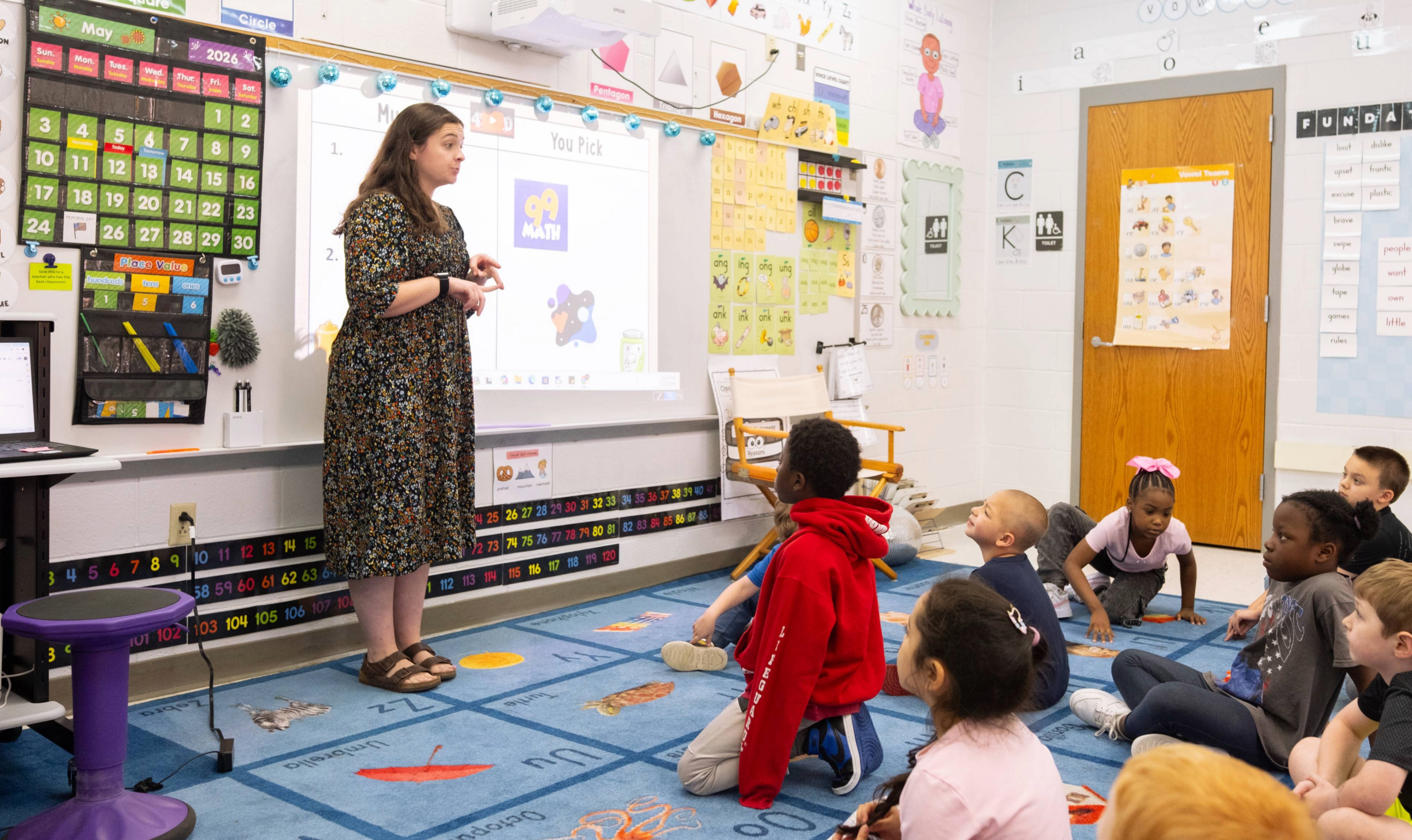
By spring, the sound of Madison Meyer’s first-grade classroom has changed.
At the beginning of the year, her students are still learning the culture of school — how to participate in a classroom community, make sense of new ideas, and persevere when learning feels difficult. They are developing foundational reading and mathematics skills while also discovering what it means to be a learner.
But later in the year, after months of daily practice, careful planning, and steady encouragement, Meyer begins to hear one of her favorite sounds.
A child giggling at a book.
Not because someone else is reading it aloud in a funny character’s voice. Not because the picture is entertaining. But because, for the first time, the story clicks into place for the student.
“You’re sitting there in April and May thinking, ‘Wow, that kid has grown so much,’” said Meyer (’23 B.A.Ed., ’24 M.A.T.), a first-grade teacher at Carolina Community Academy, Carolina’s K-2 lab school in Roxboro, North Carolina. “They’re actually having fun doing something they’ve worked really hard to get to.”
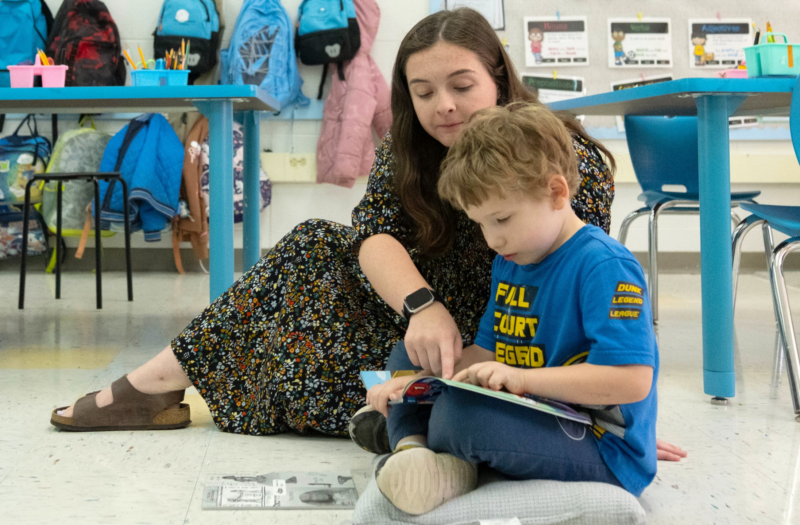
In her classroom, students move between whole-group lessons and targeted small-group instruction, with Meyer adjusting support based on each child’s needs. Sometimes that means sitting one-on-one with a child who needs something different than everyone else.
“When you’re six-years-old, you don’t know how to communicate how you learn best. Teachers have to figure that out for the child,” Meyer said. “When you come into my classroom, you’ll see every child being met with their individual needs every day.”
That daily attention has produced extraordinary results. In just her second year of teaching, Meyer’s students achieved 100% proficiency in reading and math. But those results raise an important question. What does it take to help a room full of six-year-olds make that kind of progress?
The hidden rigor of early grades
For Courtney Hattan, Ph.D., a literacy researcher and the Donald G. Tarbet Faculty Scholar in Education at the UNC School of Education, one of the most persistent misunderstandings about K-2 teaching is that because the children are young, the work must be simple.
The reality, she said, is nearly the opposite.
“I wish more people understood how complex and challenging K-2 teaching can be,” Hattan said. “Teachers need a deep understanding of every content area and the expertise to break it down in a way that’s accessible to a six-year-old.”
The early elementary years represent a critical period in children’s cognitive, linguistic, academic, and social development. Students are simultaneously learning foundational literacy and mathematics skills while developing the social and learning behaviors that will support future success in school.
“K-2 is really important because it’s building the foundation for learning for the rest of a student’s life,” Hattan said.
In literacy, that foundation extends beyond learning to identify letters, connect sounds to print, and read words accurately, Hattan said. Students are also developing vocabulary, building background knowledge, understanding narrative flow, and learning to make connections across ideas.
Research increasingly challenges the notion that children must first “learn to read” before they can “read to learn.” Instead, Hattan said, strong literacy instruction develops both simultaneously. “We want students to develop their language, vocabulary, and contextual understanding alongside those foundational skills like decoding and fluency,” Hattan said. “A really fantastic K-2 teacher is doing all of those things together.”
In practice, that means teachers are continually making instructional decisions based on students’ individual strengths and needs while simultaneously advancing multiple dimensions of learning — all within the same classroom, often within the same lesson.
“K-2 teaching is all too similar to professional dance. On stage, a dancer’s movement can appear light, graceful, and even easy. The audience sees the lift, the turn, the smooth transition from one movement to the next,” Hattan said. “What they do not see are the years of training, repetition, strength, timing, adjustment, and discipline required to make the work appear effortless.”
Visitors to a K-2 classroom may notice vibrant bulletin boards, shelves of picture books, and children gathered on a colorful rug. What they do not see are hundreds of decisions — how to group students, when to intervene, when to let a child struggle productively, how to explain a concept another way, and how to adjust a schedule to allow more time for practice.
That is the rigor of early elementary teaching. And that is the intellectually demanding work that puts Carolina-prepared teachers center stage.
How Carolina prepares teachers for the work beneath the surface
For almost a decade, many Carolina-prepared elementary teachers have entered the profession through the School of Education’s Master of Arts in Teaching (MAT)
program, which blends research-based coursework with extensive clinical experience in schools. This fall, the School expands that work with the relaunch of its Bachelor of Arts in Education (B.A.Ed.) in Elementary Education, providing undergraduates with a pathway to earn dual licensure in Elementary Education (K–6) and either Special Education – General Curriculum (K-12) or English as a Second Language (K–12).
Both of these programs have been built on a clear understanding that the early grades are not a soft entry point into education. They are among the most consequential years in a child’s academic life.
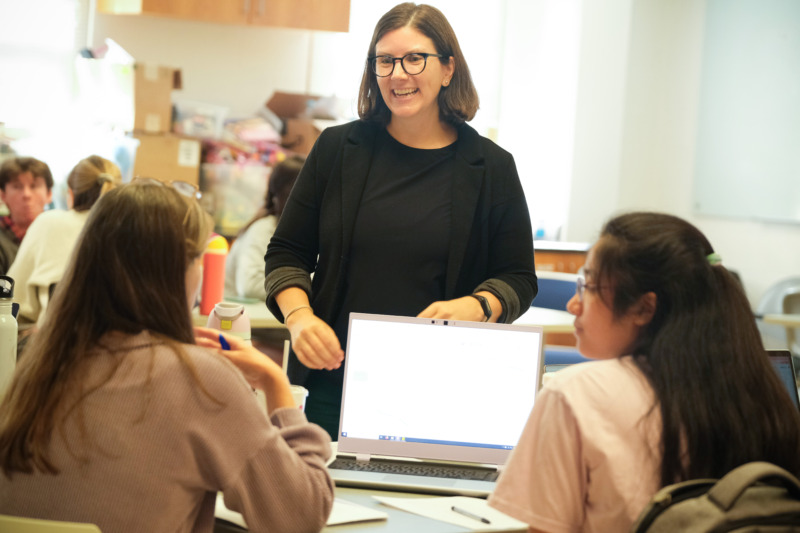
“At Carolina, we prepare future teachers to understand how young children learn and develop as readers, writers, mathematicians, historians, scientists, and problem solvers,” said Nicole Damico, Ph.D., MAT program director. “Our candidates learn how to assess student learning, make informed instructional decisions, differentiate for diverse learners, and build classroom communities where children feel safe, valued, and challenged. They understand that great teaching is both an art and a science.”
Students in both the B.A.Ed. in Elementary Education and MAT candidates learn from faculty engaged in research on literacy, learning, child development, and educational improvement at the highest level, while developing their own expertise through extensive classroom experience. Before graduation, they complete more than 600 hours of clinical practice, working alongside mentor teachers — many of whom are Carolina alumni themselves — and applying what they learn in coursework to real classroom settings.
“There is simply no substitute for working with children,” Damico said. “That is where confidence comes from. It comes from doing the work and learning from it.”
For Damico, that preparation matters because the stakes of early teaching are so high.
“The relationships they build and the foundations they help children develop can have lasting effects for years to come,” Damico said. “Every semester, I ask our students to write about a teacher or mentor who had a positive impact on their lives. More often than not, they write about an early elementary teacher.”
Preparation in practice
During her yearlong internship at Carolina Community Academy — the same school where she now teaches first grade — Meyer was challenged through her MAT coursework to help her students connect new ideas to what they already know about themselves and the world.
She sees that process unfold regularly in her own classroom.
In one unit, students learn the word “mammal” while reading about the platypus. At first, it is simply a new vocabulary word. Then comes the realization that they, too, are mammals.
“I hear them say, ‘That’s me and that’s also this platypus, and that’s so weird,’” Meyer said. “‘Isn’t the world so weird?’”
Those moments capture something deeper than simply remembering information long enough to pass an assessment. Students are connecting new ideas to what they already know, asking questions, and discovering the satisfaction that comes from genuine understanding. Preparing teachers to recognize and build on students’ existing knowledge was a foundational part of Meyer’s training at Carolina. Strengthening those connections can transform how students engage with learning, helping them build a sense of ownership.
“I didn’t want them to learn how to read fluently or get a good math grade just so I could be proud of them,” she said. “I wanted them to be proud of themselves.”
When that happens, she sees a shift. Students volunteer to share their writing. They choose books because they are curious about a topic. They approach challenging work with greater confidence and independence.
“They’re engaging with the material because they want to,” Meyer said. “That outcome matters so much more than any proficiency score.”
Evidence that preparation translates
Across North Carolina, data show that Carolina-prepared beginning teachers are helping students grow.
In 2025, EVAAS data showed that more than 95% of students in a Carolina-prepared beginning teacher’s classroom met or exceeded growth expectations.
Principals who hired UNC-Chapel Hill graduates as beginning teachers also rated them highly across the North Carolina Educator Effectiveness System standards. In 2025, their principals rated 100% of Carolina-prepared beginning teachers as proficient, accomplished, or distinguished across standards that include demonstrating leadership, establishing respectful classroom environments, knowing the content they teach, facilitating learning, and reflecting on their practice.
It marked the second consecutive year that 100% of Carolina’s beginning teachers were rated proficient on every standard by their principals.
In the end, the data only tells part of the story. It demonstrates that Carolina’s graduates are entering classrooms prepared for the work. What it cannot fully capture is what that preparation makes possible for a classroom of students.
By spring, if you’re listening closely, it might sound like a giggle from the corner of the room.