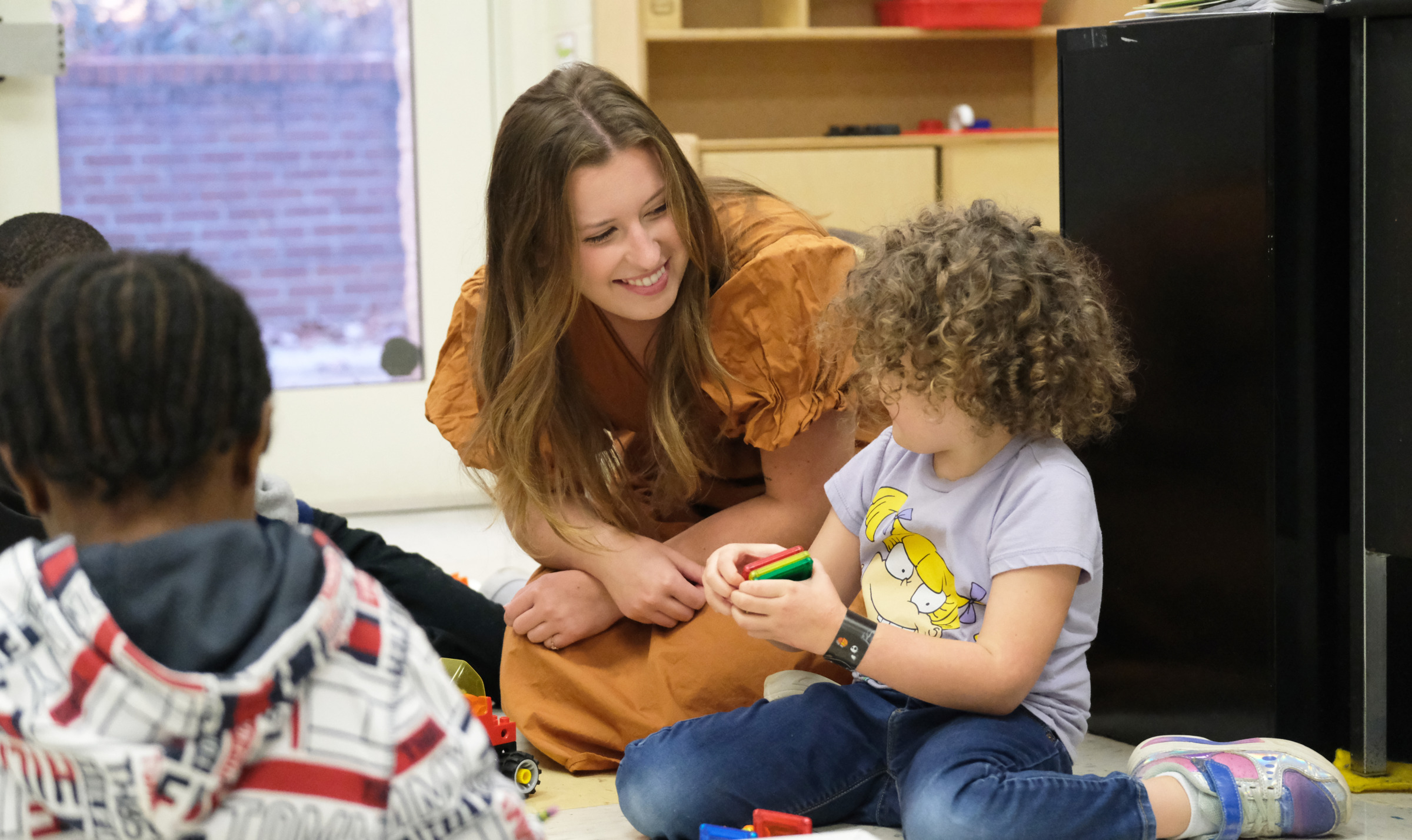
North Carolina faces critical shortages of nurses, social workers, and teachers, and UNC-Chapel Hill is addressing these needs head-on.
New initiatives in the UNC School of Education, UNC School of Nursing, and UNC School of Social Work aim to train and educate the next generation of leaders in each profession, building up the workforce to better serve North Carolinians.
Take a look at how Carolina is responding to these statewide challenges.
School of Education relaunches elementary education degree
The UNC School of Education is relaunching its Bachelor of Arts in Education in Elementary Education program, with classes beginning this fall. The program, developed by top researchers and practitioners with the diverse needs of North Carolina’s elementary students in mind, will prepare highly effective teachers to create impact in classrooms statewide.
Today’s elementary teachers support the needs of all students, including exceptional and multilingual learners. The program will be one of a few, if not the only, in North Carolina that requires dual licensure in elementary education and in either special education-general curriculum (K-12) or English as a second language (K-12). With more than 300 languages spoken in North Carolina homes and nearly 15% of public school students receiving special education services, the program’s dual licensure requirement ensures graduates are prepared to effectively respond to student needs.
“This reflects our commitment to preparing practice-ready, research-grounded teachers who will serve North Carolina, while continuing the UNC School of Education’s longstanding contributions of preparing outstanding K-12 educators for our state,” said Jill V. Hamm, the school’s dean.
“This program deepens our capacity to train highly effective teachers for North Carolina’s youngest learners and communities, while now enabling our Master of Arts in Teaching program to focus on preparing highly skilled teachers for grades 6-12. Through rigorous coursework and immersive field experiences, our graduates will be well equipped to lead, teach and support learners and communities across our state.”
The program will also provide its students with coursework in data literacy and educational technology. Graduates of the new program will leave Carolina ready to meet the challenges of today’s schools: tailoring approaches to individual student needs, using data to make informed instructional decisions, and creating supportive classroom communities.
Carolina Nursing’s graduates are state’s health care backbone
The UNC School of Nursing prepares professional, highly skilled nurses to meet the state’s most urgent health care needs through its Bachelor of Nursing and Accelerated BSN programs.
Graduates will help North Carolina mitigate a projected shortage of 12,500 registered nurses by 2033. The school increased BSN enrollment by 11% in 2025-26 and is committed to continued growth.
Nearly 74% of BSN alumni remain in the state, providing care in hospitals, clinics, schools, and communities. The Rural Providing Opportunities and Mentoring in Scholarship and Education program, or Rural PrOMISE, supports and funds graduates working in rural communities for three years after graduation.
“Nurses are essential to improving health in North Carolina,” said Valerie Howard, dean of the UNC School of Nursing. “Our BSN graduates lead, innovate and deliver exceptional care where it’s needed most.”
U.S. News & World Report ranks the BSN program No. 4 overall and No. 1 among public universities. The school offers:
- a two-year BSN with assured admission for in-state first-year students
- an accelerated BSN for those with a prior degree
- an option for military service members
Students graduate ready to become licensed professionals after completing a rigorous curriculum prioritizing hands-on clinical practice and cutting-edge simulations.
They build expertise in adult health, public health, psychiatric care, and other key areas, while developing skills in evidence-based practice, patient-centered care, leadership and interprofessional collaboration.
A nursing education building, opening in 2027, will expand training opportunities.
School of Social Work builds new pipeline
New studies show a significant shortage of social workers in North Carolina, particularly in rural areas.
Under the leadership of Dean Ramona Denby-Brinson, the UNC School of Social Work has taken on a key role in addressing this shortage.
Earlier this spring, the school announced the new Public Service Leadership Program, a multi-institutional effort led by Carolina in partnership with the North Carolina Department of Health and Human Services and the 25 in-state universities and colleges that comprise the Social Work Coalition on NC Workforce Development.
Furthermore, the school announced its intention to implement a new Bachelor of Social Work program — opening its doors to undergraduate students for the first time in its 106-year history. With its curriculum currently under review by the UNC System, the new BSW program projects to start fall 2027.
The UNC School of Social Work is nationally renowned for its Master of Social Work program, tying for No. 4 nationally and No. 2 among public universities, according to U.S. News & World Report.
The addition of a BSW will expand access to social work for Carolina undergraduates and could directly bolster North Carolina’s social work workforce.
“When we think about big-picture impact, we want to increase the number of well-trained social workers who can tackle the challenges that our state faces,” said Amy Levine, the school’s associate dean of undergraduate education.
“If we can expand the access that our undergraduate students have to social work, they can graduate with a career-ready degree that opens the door to high-demand employment opportunities, or they can enroll in our accelerated master’s program.”
In the meantime, the school launched two new introductory social work courses in January, available to all undergraduate students. Based on the success of these courses, the school will expand enrollment in both this fall.