Education
- Ph.D. 2022 – University of California-Irvine, Education (Focus: STEM Teaching and Learning)
- M.A. 2020 – University of California-Irvine, Education (Focus: STEM Teaching and Learning)
- B.A. 2018 – Duke University, Public Policy & Education
Areas of Expertise
- Learning Analytics
- AI in Education
- STEM Education
Background
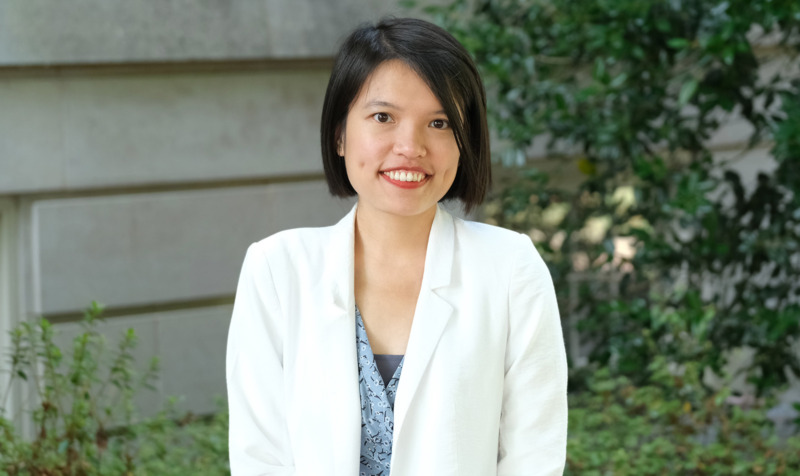
Ha Nguyen, Ph.D., designs and researches learning technologies to promote deeper STEM knowledge and competencies for diverse learners. Her interest in Education started in high school through volunteering with education nonprofits in Vietnam. This interest deepened in college, as she tutored elementary and middle school students and conducted research in public schools and nonprofits in Durham and Charlotte, North Carolina. Through these experiences, she learned the importance of two practices: cultivating local partnerships and centering students’ voices. Both practices continued to inform her research.
Before her current role at UNC-Chapel Hill, Nguyen held a faculty appointment in Instructional Technology & Learning Sciences at Utah State University.
Research
- EDUC 584, AI for Learning and Innovation
- EDUC 990, Supervised Research
- EDUC 761, Design of Emerging Technologies for Education
- EDUC 796B, Independent Study Doctoral Level
- EDUC 990
- EDUC 590, Generative AI for Learning and Innovation
- EDUC 990, Independent study
“BCSER: Supporting Ambitious and Equitable Science Learning: Leveraging AI in Developing Multimodal Formative Feedback”, Nguyen, T. C. H., Lead Principal Investigator; National Science Foundation (NSF), $349,999. (October 1, 2024 – September 30, 2027).
“Exploring Theory and Design Principles (ETD): AISciComm: Agents for Inclusive Science Communication”, Nguyen, T. C. H., Co-Principal Investigator; University of California at Irvine (UCI), $39,203. (July 1, 2024 – June 30, 2026).
“Using Artificial Intelligence to Advance Responsive Mathematics Teaching.”, Nguyen, T. C. H., Co-Principal Investigator; CFE/Lenovo Instructional Innovation, $9,497. (August 1, 2025 – May 31, 2026).
“Development of an Online System for Automated Feedback on Professional Vision for Pre-service Teachers.”, Nguyen, T. C. H., Lead Principal Investigator; UNC-Tübingen Seed, $10,000. (March 1, 2025 – May 31, 2026).
“Investigating Human-AI Collaboration in Coding Qualitative Data in Education Research.”, Nguyen, T. C. H., Lead Principal Investigator; UNC AI Fellowship, $20,568. (March 1, 2025 – May 31, 2026).
“Bridging fund for AISciComm: Agents for Inclusive Science Communication.”, Nguyen, T. C. H., Co-Principal Investigator; Spencer Foundation, $8,018. (September 1, 2025 – January 31, 2026).
Journal Article
Nguyen, H., & Hayward, J. (2025). Applying Generative Artificial Intelligence to Critiquing Science Assessments. Journal of Science Education and Technology, 34(1), 199–214.
Nguyen, H., Nguyen, V., Ludovise, S., & Santagata, R. (2025). Misrepresentation or inclusion: promises of generative artificial intelligence in climate change education. Learning, Media and Technology, 50(3), 393–409.
Nguyen, H., & Nguyen, A. (2025). Reflective Practices and Self-Regulated Learning in Designing with Generative Artificial Intelligence: An Ordered Network Analysis. Journal of Science Education and Technology, 34(5), 1178–1192.
Nguyen, H., Nguyen, V., Ludovise, S., & Santagata, R. (2025). Value-sensitive design of chatbots in environmental education: Supporting identity, connectedness, well-being and sustainability. British Journal of Educational Technology. Published.
Campos, F., Nguyen, H., Ahn, J., & Jackson, K. (2024). Leveraging cultural forms in human-centred learning analytics design. British Journal of Educational Technology, 55(3), 769–784.
Nguyen, H., & Diederich, M. (2023). Facilitating knowledge construction in informal learning: A study of TikTok scientific, educational videos. Computers & Education, 205, 104896.
Nguyen, H., Lopez, J., Homer, B., Ali, A., & Ahn, J. (2023). Reminders, reflections, and relationships: insights from the design of a chatbot for college advising. Information and Learning Sciences, 124(3/4), 128–146.
Nguyen, H. (2023). Role design considerations of conversational agents to facilitate discussion and systems thinking. Computers & Education, 192, 104661.
Nguyen, H. (2022). Let’s teach Kibot: Discovering discussion patterns between student groups and two conversational agent designs. British Journal of Educational Technology, 53(6), 1864–1884.
Nguyen, H., & Santagata, R. (2021). Impact of computer modeling on learning and teaching systems thinking. Journal of Research in Science Teaching, 58(5), 661–688.
Campos, F. C., Ahn, J., DiGiacomo, D. K., Nguyen, H., & Hays, M. (2021). Making Sense of Sensemaking: Understanding How K–12 Teachers and Coaches React to Visual Analytics. Journal of Learning Analytics, 8(3), 60–80.
Santagata, R., König, J., Scheiner, T., Nguyen, H., Adleff, A., Yang, X., & Kaiser, G. (2021). Mathematics teacher learning to notice: A systematic review of studies of video-based programs. ZDM–Mathematics Education, 53(1), 119–134.
Nguyen, H., Lim, K. Y., Wu, L. L., Fischer, C., & Warschauer, M. (2021). “We’re looking good”: Social exchange and regulation temporality in collaborative design. Learning and Instruction, 74, 101443.
Conference Proceeding
Nguyen, H., & Park, S. (2025). Providing Automated Feedback on Formative Science Assessments: Uses of Multimodal Large Language Models. Proceedings of the 15th International Learning Analytics and Knowledge Conference, 803–809.
Zhou, Y., Kang, J., & Nguyen, H. (2025). Can we trust LLM for video analysis: An exploration of hallucination in Multimodal Large Language Model. 110–118.
Khan, M. F. A., Ramsdell, M., Nguyen, H., & Karimi, H. (2024). Human Evaluation of GPT for Scalable Python Programming Exercise Generation. 2024 IEEE 11th International Conference on Data Science and Advanced Analytics (DSAA), 1–10.
Lopez-Fierro, S., & Nguyen, H. (2024). Making Human-AI Contributions Transparent in Qualitative Coding. Proceedings of the 17th International Conference on Computer-Supported Collaborative Learning-CSCL 2024, Pp. 3-10. Published.
Nguyen, H., Nguyen, V., Lopez-Fierro, S., Ludovise, S., & Santagata, R. (2024). Simulating Climate Change Discussion with Large Language Models: Considerations for Science Communication at Scale. Proceedings of the Eleventh ACM Conference on Learning@ Scale, 28–38.
Sinha, R., Solola, I., Nguyen, H., Swanson, H., & Lawrence, L. (2024). The role of generative AI in qualitative research: GPT-4’s contributions to a grounded theory analysis. Proceedings of the 2024 Symposium on Learning, Design and Technology, 17–25.
Nguyen, H., & Allan, V. (2024). Using GPT-4 to Provide Tiered, Formative Code Feedback. Proceedings of the 55th ACM Technical Symposium on Computer Science Education V. 1, 958–964.
Ahn, J., Campos, F., Nguyen, H., Hays, M., & Morrison, J. (2021). Co-Designing for Privacy, Transparency, and Trust in K-12 Learning Analytics. LAK21: 11th International Learning Analytics and Knowledge Conference, 55–65.
Nguyen, H., Ahn, J., Belgrave, A., Lee, J., Cawelti, L., Kim, H. E., Prado, Y., Santagata, R., & Villavicencio, A. (2021). Establishing trustworthiness through algorithmic approaches to qualitative research. Advances in Quantitative Ethnography: Second International Conference, ICQE 2020, Malibu, CA, USA, February 1-3, 2021, Proceedings 2, 47–61.