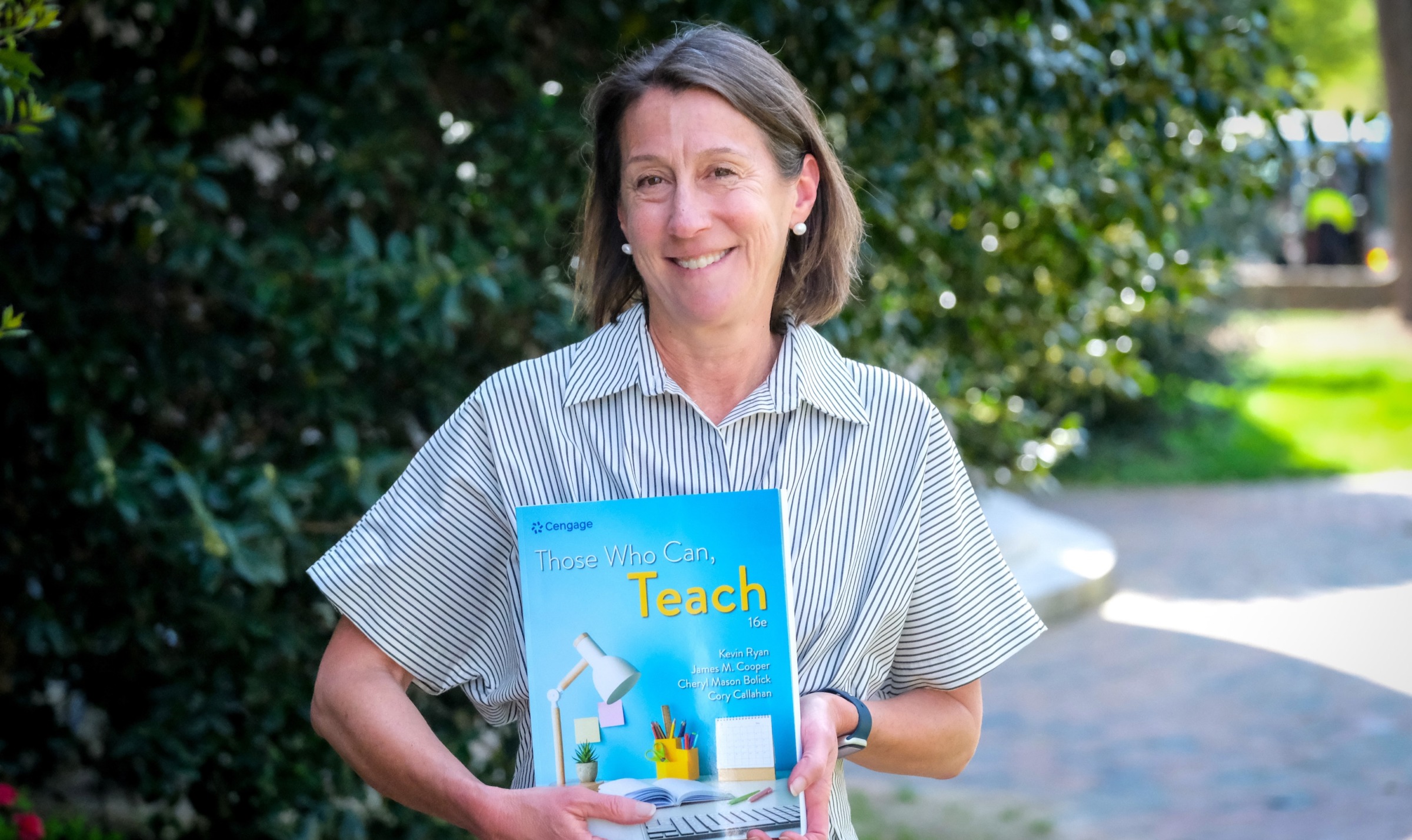
In the newly revised edition of a foundational teacher education textbook, Cheryl Bolick, Ph.D., a faculty member at the UNC School of Education, is helping prepare highly skilled educators to enter the profession with the tools needed to address the needs of students and communities in today’s educational landscape.
With the first edition published in 1972, “Those Who Can, Teach,” now in its 16th edition and published by Cengage Learning, is designed primarily for preservice teachers while also offering perspective for practicing educators, particularly those in the early years of their careers. Co-authored by Kevin Ryan, Ph.D., professor emeritus of education at Boston University School of Education; James M. Cooper, Ed.D., professor emeritus at the University of Virginia’s Curry School of Education; and Cory Callahan, Ph.D., associate professor of secondary social science, curriculum and instruction at The University of Alabama, the volume provides a broad, updated introduction to K–12 education. Through new and revised content on issues such as artificial intelligence, school choice, standards and curriculum, school funding, and federal and state policy and legislation, the textbook also encourages future teachers to reflect on their motivations, values, and evolving professional identities.
“The text aims to go beyond delivery of content related to becoming a teacher by prompting students to reflect upon their own schooling experiences and their development as a teacher,” said Bolick, who has also contributed to the 14th and 15th editions of the textbook. “We prompt students to reflect upon their motivations to enter the profession and consider how they will apply what they are learning from the text. We pose questions throughout the text that encourage them to think about how they will transfer what they are learning to their future classroom.”
Over the past 20 years, Bolick’s research has focused on how teachers learn, make meaning of the past, and translate educational experiences into classroom practice. As a specialist in social studies education and teacher preparation, she began her scholarly career by exploring innovative uses of technology, such as online education, digital history archives, and digitized primary sources, to deepen historical thinking and enhance teacher development.
More recently, Bolick has studied experiential education, examining how immersive, applied learning opportunities influence teacher growth and classroom teaching — reflecting her broader commitment to connecting theory to practice and helping future educators understand teaching as intellectual, relational, and reflective work grounded in real-world contexts.
In the following Q&A, Bolick shares insights on how “Those Who Can, Teach” reflects the changing needs of today’s classrooms and what she hopes future educators take away as they prepare to lead, teach, and support students.
Those Who Can, Teach has shaped conversations about the teaching profession for more than 50 years. What does it mean to contribute to the 16th edition of such a longstanding text?
In many ways, I feel like I am standing on the shoulders of giants. Kevin Ryan and Jim Cooper are quintessential leaders in the field of teacher education. Their work has shaped both K–12 and teacher education scholarship and practice for more than 50 years. I worked with Jim during my first academic appointment at the Curry School of Education at the University of Virginia from 1998 to 2001. He has been, and continues to be, a professional mentor and friend.
Partnering with Jim, Kevin, and Cory on the revisions means in many ways is stepping into an ongoing professional conversation that has influenced generations of educators. It involves honoring the core commitments of the text, such as teaching as intellectual, ethical, and relational work, while updating examples, research, and perspectives to reflect current realities, such as a wider mix of perspectives and lived experiences, technological change, and shifting policy landscapes.
Being part of a foundational textbook in the field of teacher education is not just about preserving longstanding impact, but about extending it and ensuring that new editions continue to challenge, support, and prepare teachers for the evolving landscape of education. 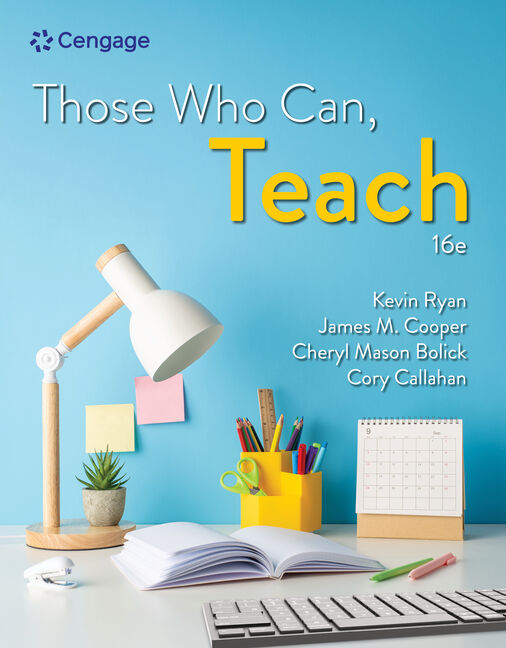
You’ve collaborated on the last three editions of the book. How does this newest edition reflect the changing realities and demands of today’s classrooms?
The text is an introduction to the field of K-12 teaching. The audience is students entering the teaching field. To best prepare them for today’s classroom, we have updated content on critical issues such as AI, school choice, standards and curriculum, school funding and federal and state policy and legislation while also including foundational content for the field of education.
This edition features new Voices from the Classroom that reflect the contemporary educational landscape. Voices from the Classroom sections are written by classroom teachers or doctoral students. Current and former School of Education students’ K-12 teaching experiences are featured in the book, including Whitney Allred Williams, Taylor Schmidt, William Pryor, Jon Walsh, Rebecca Lesnefsky, and Kerry Bartlett. Fellow co-author, Cory Callahan, and I are working with Cengage to pilot a new AI student assistant tool to accompany the text.
Your research explores social studies education, historical thinking, and how teachers develop professional identity. How are those areas reflected in the way Those Who Can, Teach helps future educators think about their role in classrooms?
The text frames teaching as both a moral and intellectual endeavor, not just a technical one. It pushes pre-service teachers to see their role as purposeful decision-makers who must balance content knowledge, pedagogy, and care for students while navigating the broader social and political contexts of schooling. The text also helps future educators understand themselves as reflective practitioners and professionals who continually examine their beliefs, biases, and instructional choices.
The text puts into practice the cornerstones of experiential education and social studies education, such as reflection, teaching through uncertainty, and inquiry-based learning. The work that I do is often around connecting theory to classroom realities. In many ways, this text does that by laying the foundation of the field through theory and research and then helping preservice and new teachers consider the application to classroom practice.
The question “Why teach?” is introduced early and revisited throughout the book. Why is that reflection particularly important for aspiring educators today?
The question “Why teach?” is especially important for pre-service teachers today, given the rapidly changing educational landscape. Clarifying one’s purpose helps future teachers navigate the challenges of teaching today while staying grounded in a clear sense of mission rather than reacting to external demands alone.
This reflection also sustains resilience and ethical decision-making. When teachers are anchored in a well-articulated “why,” they are better able to make intentional instructional choices, advocate for students, and remain committed during challenges such as burnout, policy shifts, or moments of uncertainty. Ultimately, continually returning to “Why teach?” helps educators align their daily practices with deeper commitments to learning and the long-term impact they hope to have on students and society.
This edition adds expanded content on technology, including the use of AI and digital tools. What guidance do you hope future teachers take away about using technology to support learning?
As future teachers read this text, they should see technology, including AI, as a set of tools that can deepen thinking and support deeper learning when used intentionally. The text encourages students to choose technologies that enhance inquiry, collaboration, and critical analysis rather than simply increase efficiency or engagement on the surface. The textbook also encourages students to use a critical lens to question issues of bias, accuracy, privacy, and accessibility while modeling responsible use for students.
From first-year teaching to issues of professionalism and reform, the book addresses many challenges educators face today. How do you see it supporting the work happening in teacher preparation programs and schools now?
I see this textbook as a means to bridge theory, practice, and policy at a moment when educators face complex and rapidly changing demands. It provides a shared language for discussing core issues such as foundations of education, classroom management, accessibility, curriculum design, assessment, and policy—while grounding those conversations in real classroom contexts that preservice and early career teachers can recognize and apply.
Also, it helps students connect coursework to field experiences, encouraging reflection on decision-making, and preparing them to navigate the realities of schools with both flexibility and purpose. In schools, it supports ongoing professional growth by framing teaching as collaborative, inquiry-driven work, where educators continually adapt, advocate for students, and engage with reform efforts thoughtfully rather than reactively.