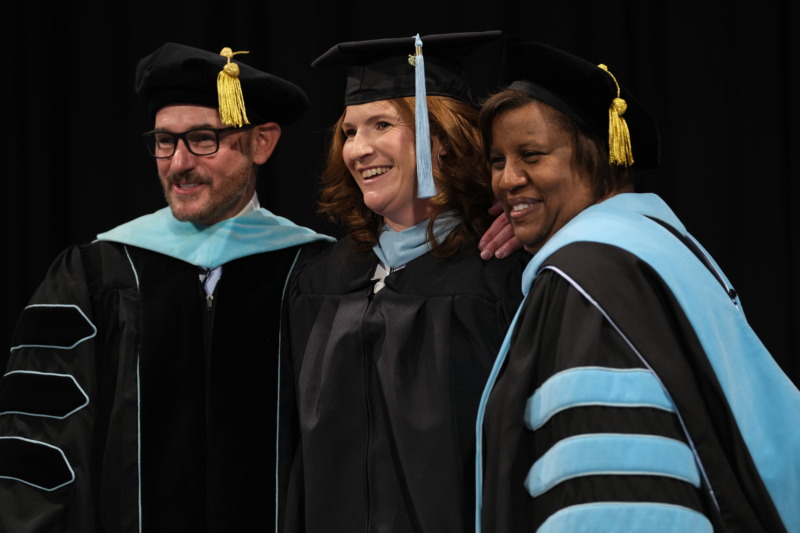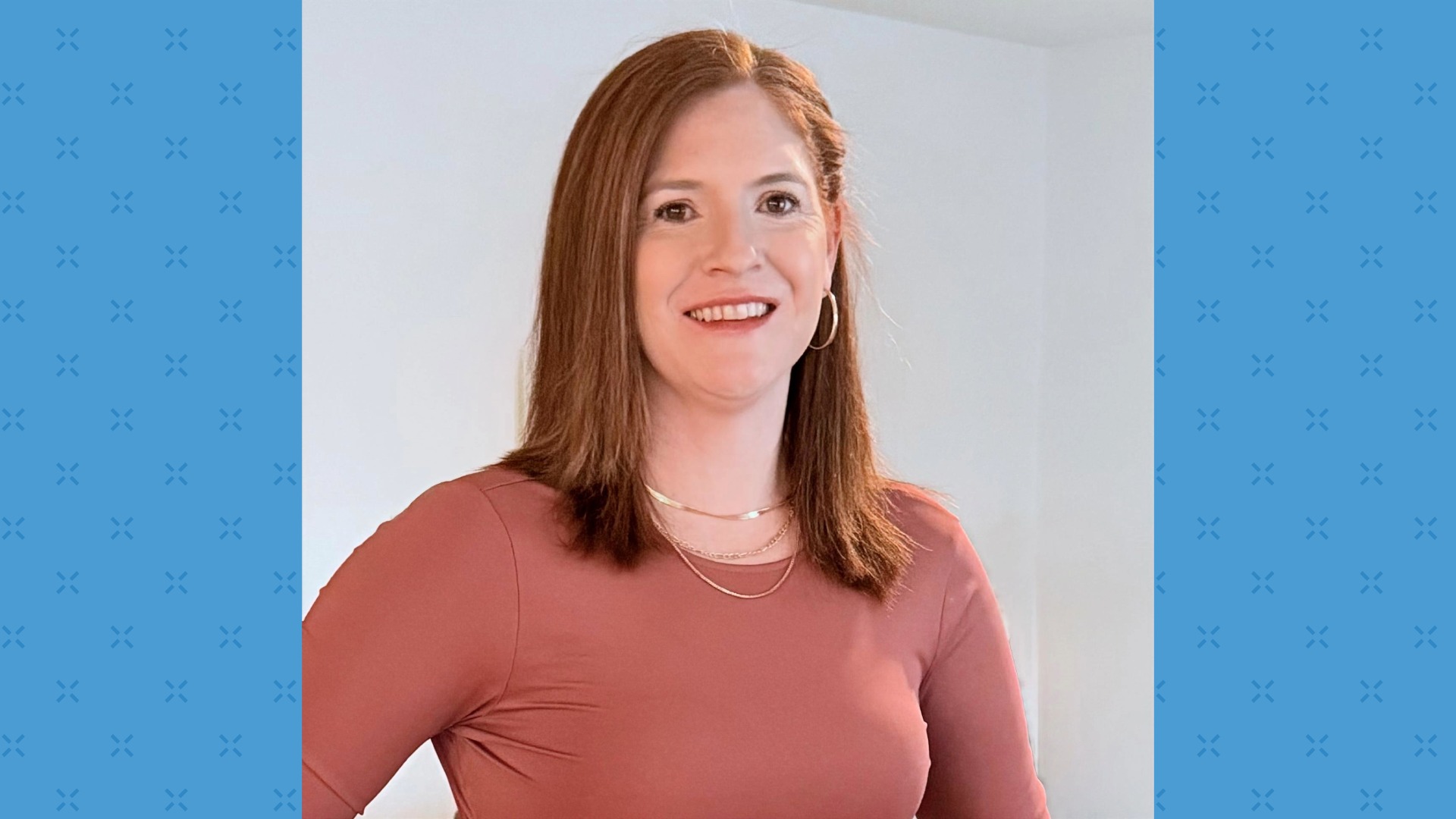
Hope Heverly, an experienced educator with 15 years in education, has built her career around relationships and a collaborative approach to supporting students and teachers. Earlier this spring, Heverly was named assistant principal of Carolina Community Academy, an innovative school for K-2 students in Roxboro, North Carolina, a partnership between the University of North Carolina at Chapel Hill and Person County Schools. She graduated with her Master of School Administration this May.
“I knew I always wanted to be a teacher, and getting to live out that career has made me even more passionate about education,” Heverly said.
As she moved through her career in elementary education, Heverly began to see leadership as a way to support not only the students in her own classroom but also the teachers working alongside her.
“I was challenged by an administrator about four years ago [who asked], ‘Did you ever think of the impact you could have on more students if you took on more of a leadership role in being a math coach?,’” she said. “I realized that while I love teaching math, I found I could have a broader impact by collaborating with other educators. That’s when I realized the shift would give me the opportunity to influence more students than I could alone.”
That realization led Heverly to transition into a math coach role within Orange County Schools, where she spent three years supporting teachers through co-teaching, professional development, and data analysis. In that time, she found herself drawn not only to instructional support, but also to the relationships that made her work meaningful. Providing teachers with tangible, hands-on support helped clarify the direction she wanted to pursue and ultimately led her toward school administration.
Designed for experienced educators, the School’s Master of School Administration program prepares students to lead with purpose, respond to student and community needs with intention, and make an immediate impact as licensed K-12 principals. The two-year, cohort-based program — which is hyflex, providing online and in-person class options — blends rigorous coursework with real-world administrative experience to help future school leaders develop the skills and confidence to navigate the complex demands of today’s educational landscape. For Heverly, that preparation aligned closely with the next stage of her professional path.
Heverly said her experience block teaching math alongside a co-teacher at the elementary level showed her the value of partnership and the broader impact she could have by supporting fellow teachers.
“Every student deserves a champion, and every teacher deserves a partner,” Heverly said.
Growing through mentorship and community
Heverly said the MSA program’s hyflex format — which offers academic courses in concentrated six-week blocks on Wednesday evenings online and select Saturdays in both online and in-person formats — made it possible to continue creating impact in math classrooms while building toward school leadership.
“It was really helpful in two ways, especially during the first year, when you’re doing most of the classes, the hybrid format gave flexibility,” Heverly said. “After working a full day, it was helpful not to have to rush to campus every time. That flexibility made it easier to balance being a full-time math coach while working toward becoming an administrator.”
At the same time, Heverly found that the program’s in-person components added another layer of value to her experience. While the online format supported the schedules of working professionals, time spent on campus helped strengthen the relationships that became central to her growth.
“It felt like a really great balance,” Heverly said. “During the week, everyone was still working full-time, so the online option was beneficial. But there’s also a lot of value in being in person, and the program ensured the cohort had that cohesive, hands-on learning experience.”
That sense of connection extended beyond the cohort and into Heverly’s relationships with faculty mentors. She said one of the most defining parts of the program was feeling supported not only as a student, but as an emerging leader.
She described Chris Scott, Ed.D., and Program Director Martinette Horner, Ed.D., as honest, supportive mentors who made her feel seen as an individual rather than just a student. She also noted that Horner’s encouragement to pursue the opportunity at Carolina Community Academy reflected how well the program’s faculty understood her passions and leadership potential.
“A big strength of the MSA program is that you’re not just a student in the classroom,” Heverly said. “The faculty want you to get a job that truly fits who you are and what you stand for, while also pushing you to grow as a leader.”
That preparation was reinforced through her internship. Instead of completing it in an elementary setting, Heverly chose Orange Middle School, where she worked with the school’s principal, Jayme Bell-Williams, and gained extensive hands-on administrative experience. She said Bell-Williams made it clear that she was part of the team, invited her perspective, and ensured she had meaningful opportunities to grow before moving into her next role.
Through the internship, Heverly analyzed data, helped coordinate middle-of-year testing, and supported behavioral processes — experiences that affirmed her growth as a school leader and helped shape the kind of administrator she aims to be.
“Whether it’s from a student lens or a colleague lens, I want people to know they’re never alone,” Heverly said. “You have a thinking partner. You have someone there on your tough days. It’s about consistently showing up and giving your best each day, even though your best may look different from day to day.”
Now serving as assistant principal at Carolina Community Academy, Heverly sees her current role as a continuation of the same learning, mentorship, and partnership that shaped her experience in the program — working with Principal Daniel Watson (’18 M.S.A.).
“I’m really excited to still be part of Carolina in this way,” Heverly said. I’ve learned so much these past two years, and I’m excited to continue working with Carolina through Carolina Community Academy and to keep building my leadership skills.”