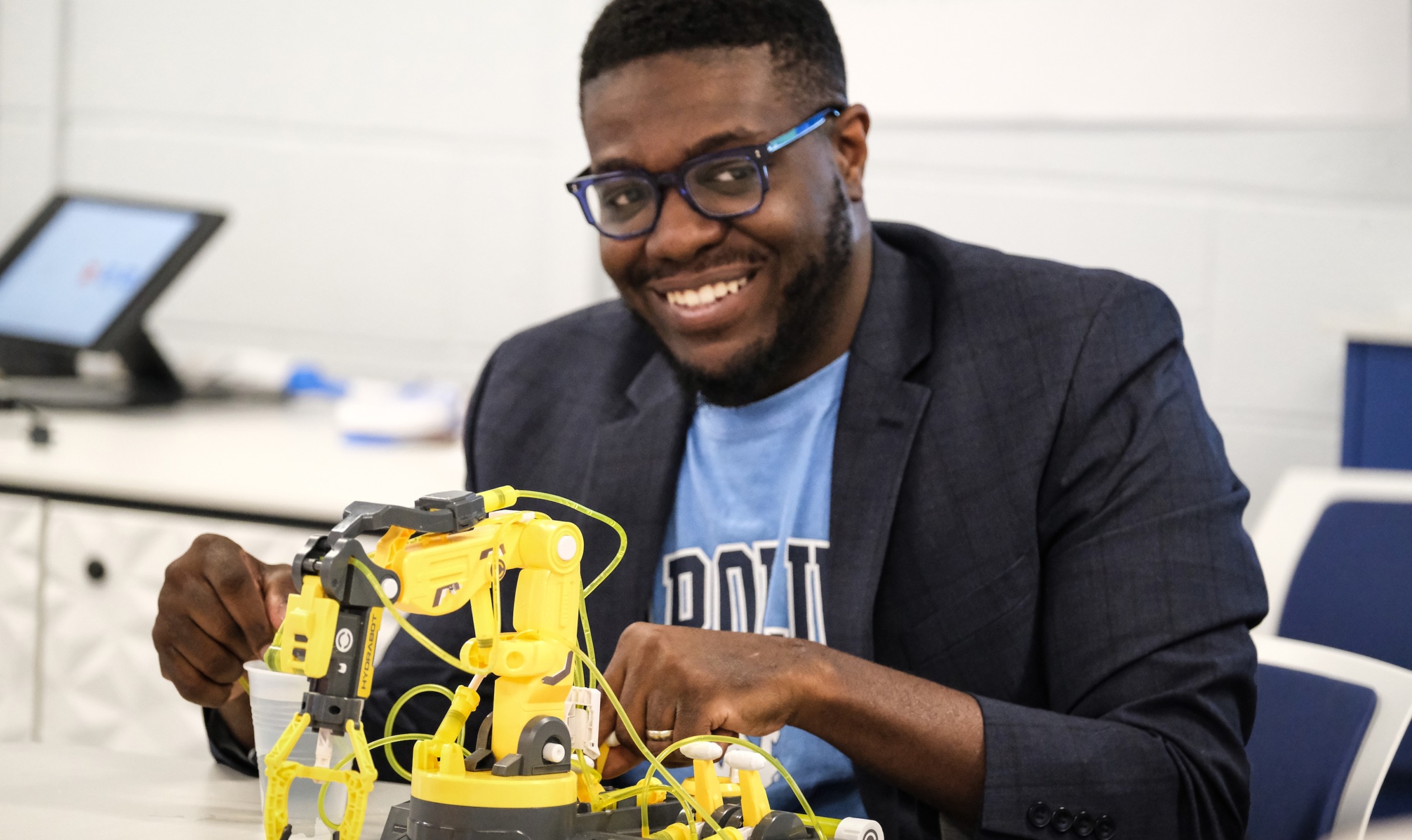
STEM PLUG initially began with a children’s book.
Published in 2022, “Diverse in STEM” introduced characters designed to help young learners see themselves in science, technology, engineering, and mathematics. For Rich Gilliam, founder of STEM PLUG and a 2026 graduate of the UNC School of Education’s Master of Arts in Educational Innovation, Technology, and Entrepreneurship program, the book was the first step in what has become an organization focused on strengthening STEM identity among K-12 students and educators.
STEM PLUG now uses children’s books, robotics kits, and educator development to help students and educators build confidence in STEM.
Gilliam said his work helping young learners see themselves in STEM is rooted in his own journey — one that began with a high school project inspired by watching his aunt navigate kidney disease.
“I became interested in science around my 12th-grade year after doing a high school project on kidneydisease,” Gilliam said. “That project showed me how kidney disease affects the body and how science connects to the body. I began to see how science really correlates to my everyday life.”
That realization led Gilliam to Saint Augustine’s University, where he graduated in 2015 with a Bachelor of Science in biology. From there, Gilliam built a career in science and engineering, working in neuroscience research and laboratory engineering roles that gave him the technical foundation and professional experience that would inform his work as an education entrepreneur.
“As an entrepreneur, especially within the work I do in robotics, a lot of it requires a lot of patience and troubleshooting,” Gilliam said. “Coming from an engineering background, having an attention to detail has been really important, and that has transferred over to me as an entrepreneur.”
The organization began while he was still working in corporate science and engineering, but as STEM PLUG grew, Gilliam began looking for a graduate program that could help him connect his technical background with educational standards, learning design, and entrepreneurship.
Gilliam’s search led him to the MEITE program, which aligned his existing work with STEM PLUG and provided the research-informed framework he needed to strengthen and scale its impact.
“My interest in the program came from wanting to bridge my technical experience with educational standards and really understand the education realm more deeply within technology,” Gilliam said. “Since I’ve been at Carolina, I’ve had advisors who have been part of STEM PLUG and have given me advice, and I’ve also been able to get funding that helped move the needle for us. It’s been a structure that has pushed us not only financially, but strategically, helping me understand education on a deeper level.”
That support has helped Gilliam move STEM PLUG from an early concept to a growing social impact venture with clearer strategy, stronger partnerships, and expanding reach through campus-based pitch competitions and grant opportunities — including support connected to Innovate Carolina and the 1789, UNC’s Student Innovation and Entrepreneurship Hub — as well as funding from NC IDEA.
Within the School, Gilliam has also begun building connections with faculty members, including Matthew Bernacki, Ph.D., and Keith Sawyer, Ph.D. Those conversations have helped him refine the venture’s direction, expand its books, robotics programming, and educator partnerships, and think about future research possibilities and the long-term direction of his work.
“The work that I’ve done within the MEITE program has been significantly application-based,” Gilliam said. “One of the things I’m going to take from the MEITE program and from my classes is continuing to understand the big picture and seeing where I can apply those concepts.”
Connecting STEM learning to identity
Gilliam’s vision for STEM PLUG quickly expanded beyond the page.
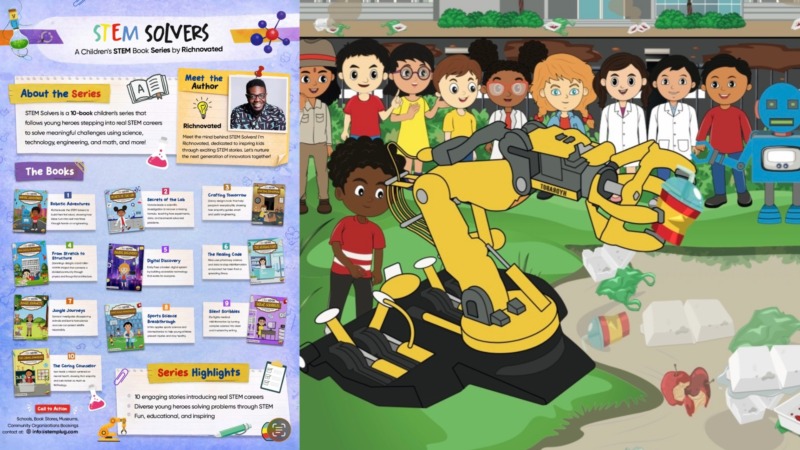
In 2025, STEM PLUG released “Robotic Adventures,” the first book in its STEM Solver series. The book follows its protagonist, Richie, and his classmates as they develop a robot to help clean up the environment. Alongside the story, Gilliam and his team created a robotics kit that enabled students and educators to build a hydraulic robot connected to the book’s storyline.
For Gilliam, storytelling and hands-on learning are intentionally connected. Through MEITE, he said he has been able to ground that work more deeply in learning research and instructional design, applying course concepts and mentorship directly to STEM PLUG as he considers how students engage with STEM content and how educators adopt new tools in real classroom settings.
“Learning sciences really opened my eyes, especially when thinking about how different environments shape how children learn,” Gilliam said. “I knew that everyone learned differently, but my courses helped me better understand the details behind that. They helped me think more deeply about the learning environments students experience and how those environments shape the way they engage with STEM.”
That deeper understanding, Gilliam said, has shaped how he approaches STEM PLUG not only as its founder, but also as an edupreneur thinking about sustainability and educator preparation. Through this, Gilliam is developing the next nine books in the STEM Solver series, creating a 10-book collection that pairs literacy with hands-on robotics experiences.
“When I developed the first book, I had the vision of turning it into a series,” Gilliam said. “The first book introduced all the characters, but it costs money to publish children’s books. I’ve always been someone who likes to prove a concept, have people believe in it, and then push the needle even more. After people saw the first book, I got more buy-in, which led to pitch competitions, funding, and the ability to develop more offerings within STEM PLUG.”
Gilliam said the venture’s growth has been collaborative. Its team includes a chief operating officer, interns from UNC-Chapel Hill and UNC System universities, contractors who support resource development, a publishing team that creates illustrations, and a manufacturer that builds the robotics kits.
That team-based approach, Gilliam said, has helped STEM PLUG expand its work with schools, after-school programs, museums, and educator groups across North Carolina and beyond.
“The MEITE program shaped me to think bigger than just building a solution,” Gilliam said. “It taught me how to deeply understand problems, collaborate across different perspectives, and create systems that bring people together to solve real challenges in education. Because of that, I now see STEM PLUG not just as a company, but as a collaborative movement focused on empowering students, supporting educators, and building meaningful partnerships with schools, museums, and districts to create lasting impact.”
Supporting educators, reaching students
In addition to working directly with students, Gilliam shared that STEM PLUG is increasingly focused on professional development for educators.
Gilliam sees educator preparation as essential to the organization’s long-term impact. His experience in MEITE helped him understand that work is more than outreach — instead, as a model for sustainable educator development that benefits both teachers and students.
“Strong partnerships enable STEM PLUG to provide professional development on building our robots and using the books from a STEM identity standpoint,” Gilliam said. “From there, educators could co-create curriculum and make STEM PLUG products accessible to all learners.”
As a graduate of the MEITE program, Gilliam said he is focused on continuing to build STEM PLUG with the strategy and tools strengthened through his time in the School. The experience, he said, helped him deepen existing skills, develop new ones, and think more intentionally about educator preparation.
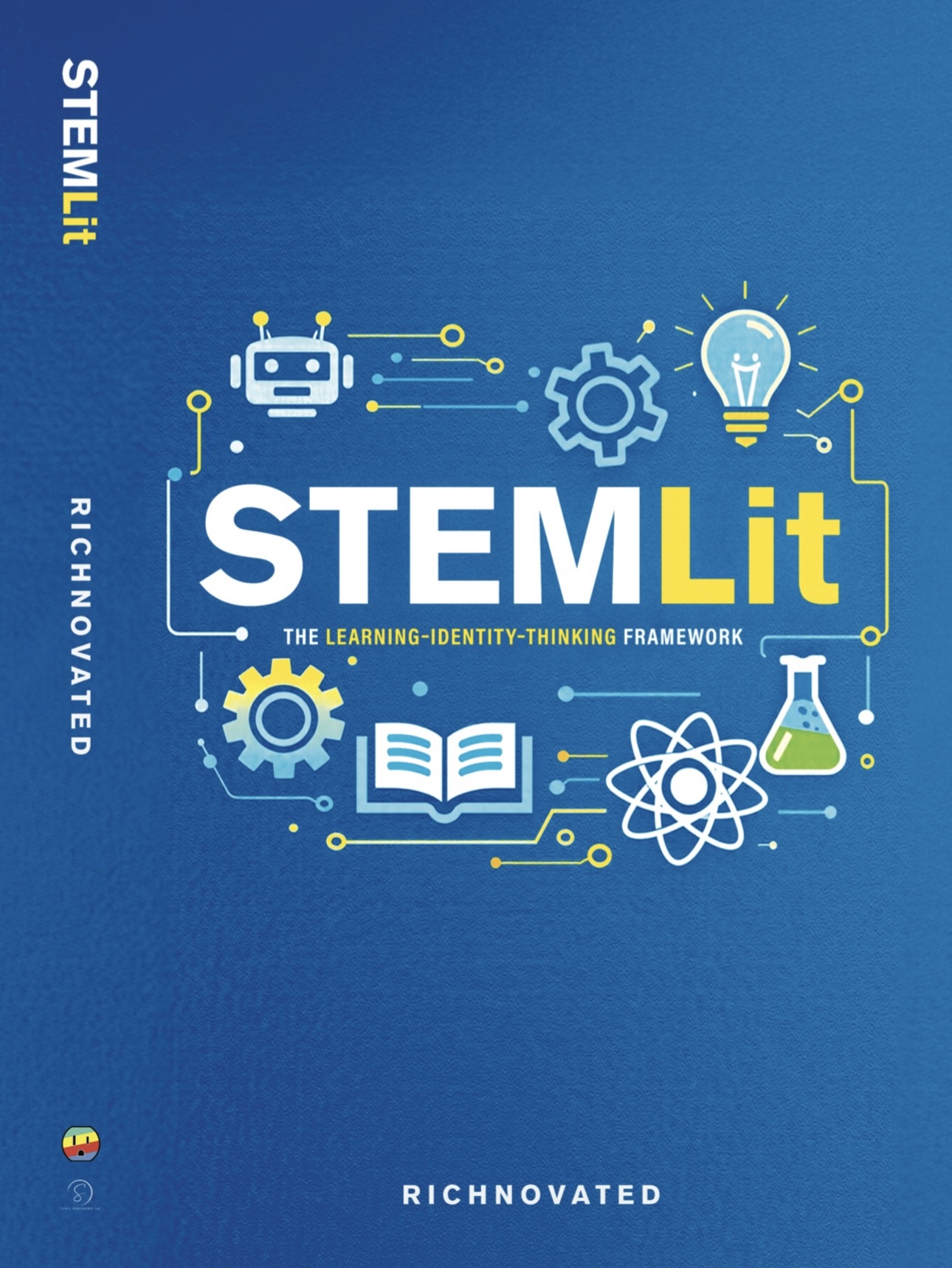
Gilliam said upcoming projects include educator professional development offerings, a framework book titled “STEM Lit,” and exploratory work toward an AI-supported learning tool connected to STEM PLUG’s characters. Together, he sees those efforts as part of a broader ecosystem designed to help students — especially those who may not encounter STEM early or often — see what is possible.
“Helping kids within STEM is not just a nice-to-have; it’s a need-to-have,” Gilliam said.