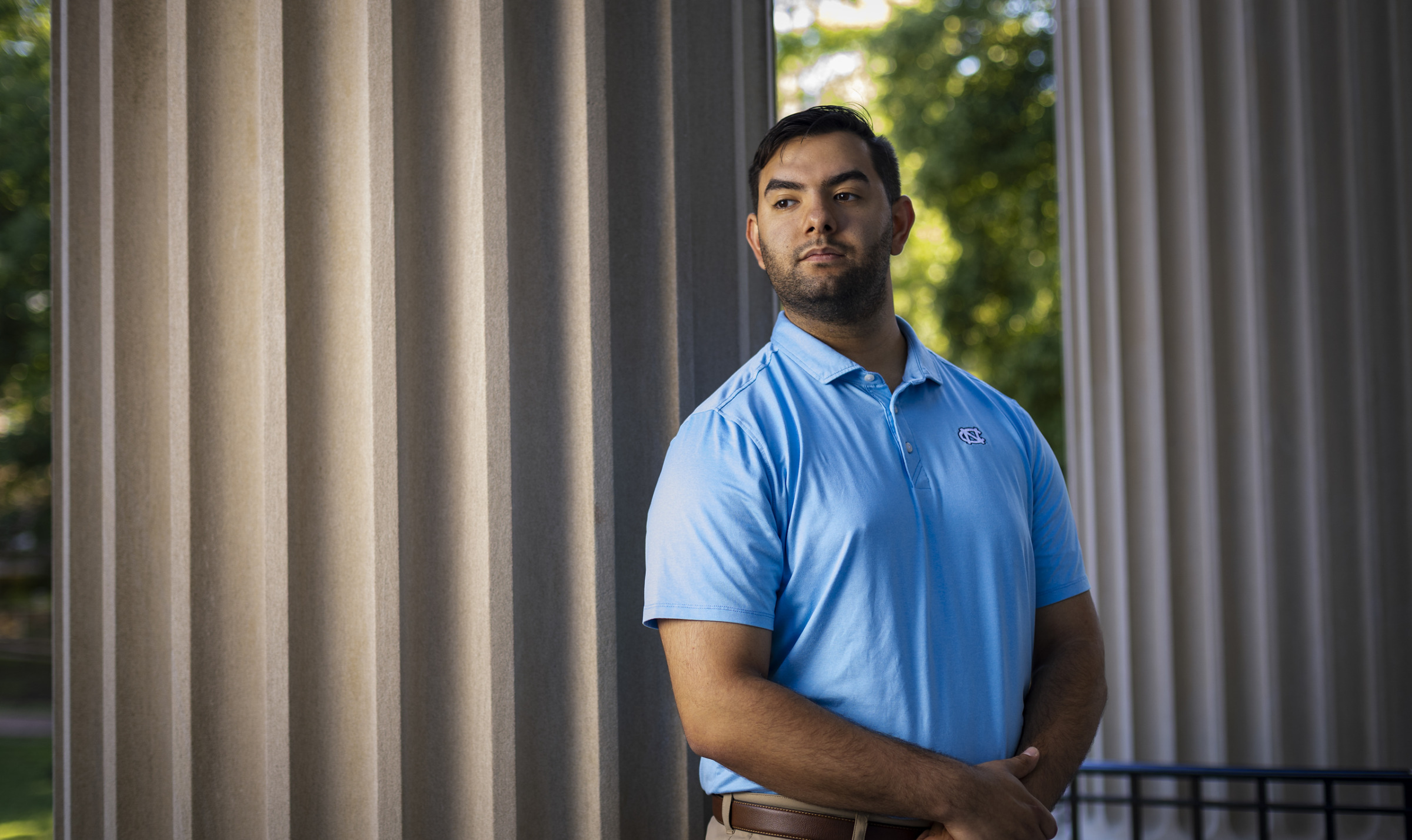
When Carlos Sacerio transferred to UNC-Chapel Hill in 2025, he was surprised that more of his military training didn’t count toward his degree.
While earning an associate’s degree at Wake Technical Community College, he completed training through the U.S. Army’s Cyber Center of Excellence. He joined the National Guard in 2023 for the educational opportunities it provided, serving one weekend a month while gaining technical training and receiving tuition assistance for college.
But when it came time to transfer to a four-year university, he discovered that moving military credits into a degree program is not always straightforward.
“When institutions do not recognize applicable military training, students may have to repeat material they have already mastered, spend more money, and take longer to graduate,” he shares.
Support from a Summer Undergraduate Research Fellowship (SURF) and the UNC McNair Scholars Program gave Sacerio, now a senior at the UNC School of Education, the opportunity to investigate why that happens. This summer, alongside professor Daniel Klasik, he studied how UNC System universities evaluate military education and training and determine whether it can count toward degree requirements.
“I am studying whether these rules and decisions differ across universities and how those differences affect military-affiliated students,” he says. “The goal is to understand how colleges can make the process clearer, fairer, and easier for students to navigate.”
Drawing on his own experience as a service member and transfer student, Sacerio hopes to publish his research to inform new policies and strengthen existing practices that support those who have served or taken nontraditional pathways.
UNC Research Stories spoke with him about his project, the challenges he encountered, and what he learned through the research process.
What sparked your interest in this particular research topic?
Throughout my military service, I have met soldiers from many backgrounds who wanted to pursue college degrees but weren’t sure how to begin. I have helped many explore community college pathways and educational resources, which strengthened my passion for making higher education more accessible.
You have completed training as a signal support systems specialist. What does that role involve?
My job is to help ensure secure communication in tactical environments and government workspaces. I troubleshoot networks, routers, and switches, and I program radios that connect to satellites and other communication systems.
Essentially, I make sure teams can get on the air and communicate reliably to accomplish their objectives and complete their missions.
What was it like to transfer military credit to UNC-Chapel Hill?
I reached out to university staff involved in undergraduate curricula to better understand why my military training couldn’t transfer over. The process was frustrating because I felt there were legitimate reasons why some of that experience could count toward degree requirements.
One challenge is that military training is often evaluated using recommendations from the American Council on Education, which do not always provide universities with enough detail to determine how the training aligns with specific courses. As a result, none of my military training counted toward classes at UNC-Chapel Hill.
That experience ultimately motivated me to study why this issue affects so many students like me.
What are the main goals of your SURF project?
The primary goal of my project is to understand how UNC System institutions evaluate military training and prior learning for college credit. I am examining students’ experiences, university policies, and differences in how those policies are applied across campuses.
Ultimately, I hope this research identifies ways to make the process more transparent and consistent so that military-affiliated students can avoid repeating coursework, reduce educational costs, and stay on track to graduate.
Share a challenge that arose during your research project this summer.
One of the biggest challenges was recruiting participants during the summer, when students tend to check their university email accounts less often. Recruitment also depended on individual universities reviewing and distributing the study announcement through campus listservs, which sometimes delayed the process.
Although I had fewer participants than I initially hoped, I focused on collecting detailed accounts from those who did participate and connecting their experiences to university policies and existing research. This taught me how to adapt a project while still honoring the importance of every participant’s story.
I also completed two weeks of annual National Guard training during the research period, which limited my access to some of the equipment I needed. To stay on track, I planned around the interruption and adjusted my schedule so I could meet both my military and research responsibilities.
How has this research experience changed the way you think about your field or about problem-solving in general?
This experience taught me that adopting a policy does not automatically guarantee students will benefit from it as intended. How a policy is interpreted, communicated, and implemented at the campus level matters just as much as the policy itself. It also taught me to approach problems from multiple perspectives, including those of students, administrators, and policymakers.
Research has reinforced the importance of flexibility. When the available data do not support the original plan, the answer is not to abandon the question but to identify another way to investigate it.
What would you say to students who feel intimidated or unsure whether they belong in research?
Feeling intimidated can be a sign that you care deeply about what you are trying to accomplish. Research is not about having all the answers from the start. It is about being curious enough to ask meaningful questions and persistent enough to follow where the evidence leads.
Every researcher has experienced uncertainty or worried that their work was not good enough. You belong in research because your experiences and questions can offer a perspective that someone else may not have considered. We all start somewhere, and confidence develops through the process.
If you could sum up your summer research experience in one word or phrase, what would it be and why?
“I am an expert, and I am a professional.” That’s a line from the Soldier’s Creed.
That phrase reflects the discipline, persistence, and responsibility I brought from my military service into my research. I did not begin the summer with all the answers, but I committed myself to learning, adapting, and producing work that could help universities better support military-affiliated students.