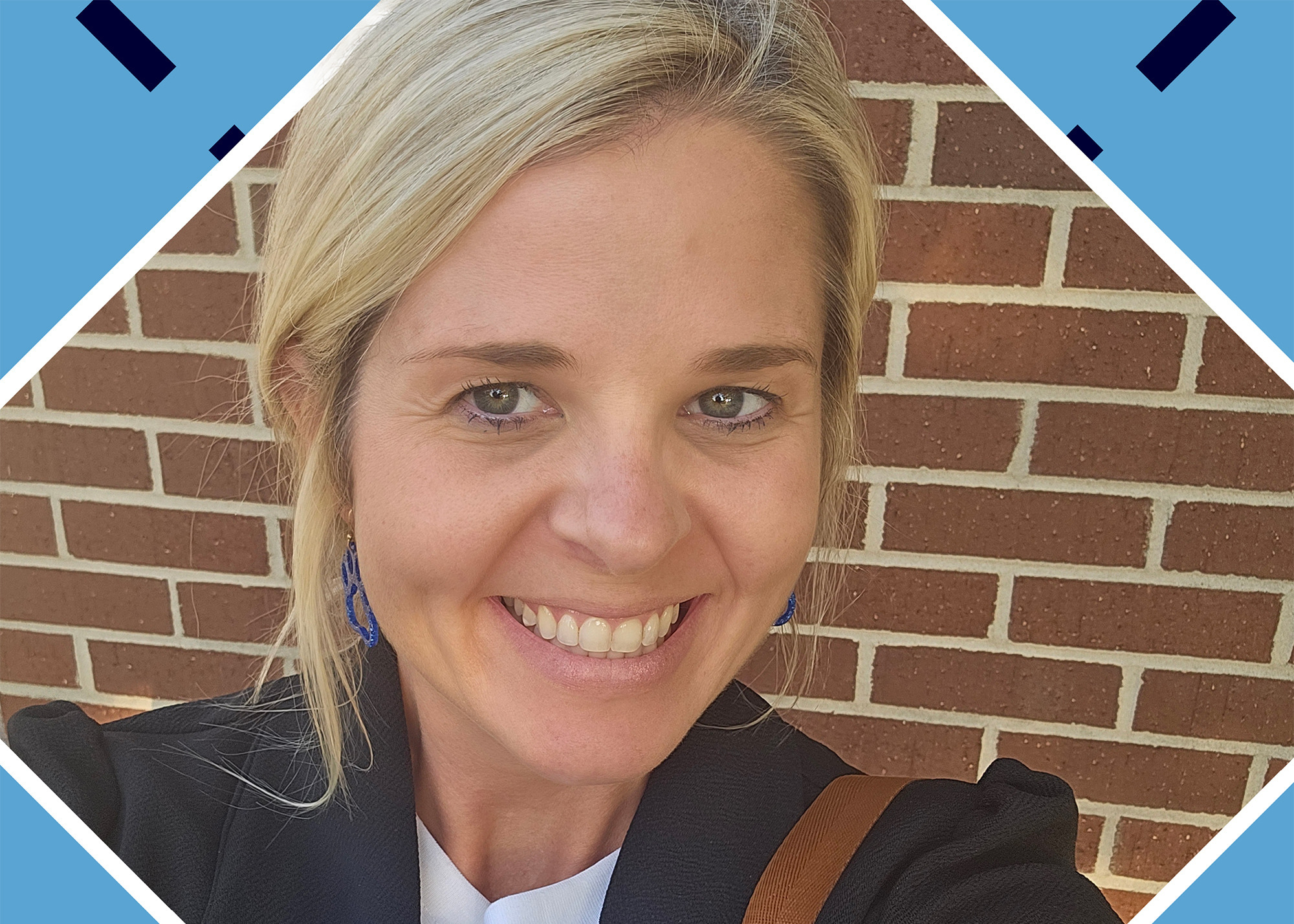
Emily Reagan has spent her career in education asking a question that has steadily expanded the scope of her work: How can I help more students succeed?
It’s a question that has taken her from teaching high school chemistry to curriculum and instructional leadership to school administration. Now a second-year student in the UNC School of Education’s Master of School Administration program, Reagan is putting those experiences together as an administrative intern, instructional coach, and academically or intellectually gifted teacher at Williamsburg Elementary School in Rockingham County Schools.
There, in Reidsville, Reagan is learning to lead from multiple vantage points, working alongside teachers, school administrators, and district leaders to strengthen instruction and create opportunities for students.
“I want to help my kids,” said Reagan, thinking back to why she pursued an M.S.A. degree. “What better way to do that than help the teachers?”
That realization began taking shape earlier in Reagan’s career. She earned a degree in biochemistry and entered education as a high school chemistry teacher. When her own children reached elementary school, she became increasingly interested in how students build foundational skills, especially as she helped her daughter learn to read during the COVID-19 pandemic.
Reagan eventually earned a master’s degree in curriculum and instruction and moved into curriculum leadership before taking an administrative role in Caswell County, where she worked with five schools on improvement planning, student data, and instructional needs.
For Reagan, becoming a principal was always a possibility, but one she wanted to approach deliberately.
“I want to do it right,” she said. “I can’t be an instructional leader of a building if I don’t know what you’re teaching, if I don’t know your standards or strategies.”
That philosophy is shaping her work at Williamsburg.
Reagan and district leaders are examining reading and mathematics data to identify the skills students need to master and the students who need additional support. Rather than asking teachers to address every challenge at once, they are narrowing their focus to high-leverage foundational skills most critical to student success.
“Data is great, but it’s not the how. It’s the what,” Reagan said. “It tells me who and what, but it doesn’t tell me how to do it.”
Reagan helps translate that “what” into action, meeting weekly with grade-level teams, conducting classroom walkthroughs, and working with district staff on instructional planning.
The “how” has been the focus for Reagan and a team identifying grade-specific challenges across the district and then implementing practices to meet those challenges and increase student proficiency. For example: Data showed that several kindergartners struggled to name all of the letters of the alphabet. Reagan and her colleagues provided pinpoint instruction to ensure those students have the sound and phonemic awareness to succeed in first grade.
For Reagan, the work at Williamsburg has become a real-world extension of the MSA program, helping her bridge the gap between understanding instruction and leading people.
“The program has been that tool in my toolbox,” she said, helping her learn how to build relationships, navigate resistance, and develop the buy-in necessary for schoolwide improvement.
Her cohort has become another resource. Because classmates work in rural and urban districts across North Carolina, Reagan can bring challenges to peers who understand different educational contexts.
Together, that blend of coursework, peer learning, and daily practice is helping Reagan develop the leadership approach she hopes to carry into a future principalship.
“I will love you and support you, but I have high expectations for you,” Reagan said. “I think that momentum of, ‘She expects a lot out of me, and she’s willing to help me get there,’ is the impact I hope I will leave.”