
The email could have been an easy one to miss.
As a UNC-Chapel Hill undergraduate juggling coursework in psychology and in the School of Education’s Human Development and Family Science program, Courtney Medina (’21 B.A.Ed.) was on her way to a career focused on improving mental health. She was already completing one research experience in a psychology lab focused on child cognition and life experiences.
But an email call for undergraduate research assistants for the Research Addressing Violence in Education (RAVE) Lab — led by School of Education faculty member and William C. Friday Distinguished Professor of Education Dorothy Espelage, Ph.D. — caught Medina’s attention.
The lab’s focus immediately stood out to Medina. Espelage and her team were exploring a range of topics that included teen dating violence, sexual harassment, bullying prevention, and adolescent well-being.
For Medina, who had seen the effects of mental health challenges and interpersonal violence impact people she cared about, the opportunity sparked immediate curiosity.
“At that point in my life, I wasn’t aware that research was being conducted on those kinds of things and that people dedicated their whole careers to this kind of research,” Medina said.
She joined Espelage’s RAVE lab, immersed herself in hands-on research, and began asking questions that continue to shape her career and future.
Today, as a fourth-year clinical-developmental psychology doctoral student at the University of Pittsburgh studying how social and cultural forces influence adolescent mental health, Medina said much of her professional journey traces back to that email and to the Human Development and Family Science program, which taught her to look beyond individual experiences and examine the systems and communities that shape them.
Looking beyond individual experience
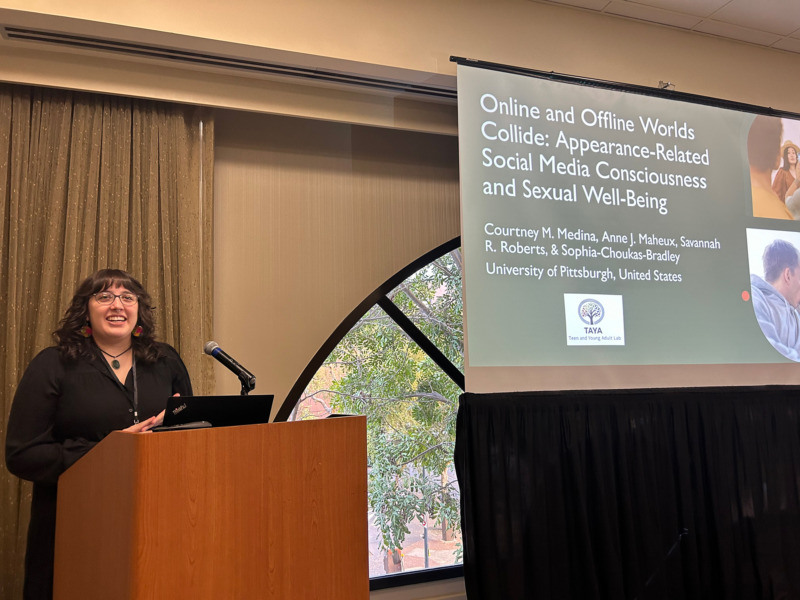
At Pitt, Medina’s research explores how experiences related to gender, appearance, sexuality, and social media influence the ways young people see themselves and navigate the world.
A major focus of her work seeks to better understand self-objectification, a process in which individuals focus on how their bodies and appearances are perceived by others. Drawing on objectification theory, she examines how experiences such as sexual harassment, appearance-based comments, and interpersonal objectification can contribute to anxiety, depression, and shame — and how to prevent those negative mental health outcomes.
For that work, in 2025, Medina was awarded a National Science Foundation Graduate Research Fellowship, among the most prestigious and competitive awards to student researchers.
She also works closely with her advisor, Sophia Choukas Bradley, Ph.D. — a UNC-Chapel Hill psychology doctoral alumna, Pitt faculty member, and director of the Teen and Young Adult Lab — on grant-funded research projects on social media use, body image, and mental health, as well as with Andrea Medrano, Ph. D., whose research examines the impact of violence on Latinx youth.
Medina hopes her research will inform interventions that help adolescents recognize and contextualize their experiences. Rather than internalizing harmful messages about their appearance or worth, she is interested in helping young people see how broader societal forces, including gender norms, sexism, and social media dynamics, shape their experiences.
“When I think about the classes I took for the HDFS major, I’m appreciative because that set me up to think of human development from a more structural level,” she said. “The coursework exposed me to thinking about community-level factors and family-level factors… In my work now, I’m always thinking about the socioecological framework, which considers how development is influenced by multiple contexts. Ideas I first encountered in HDFS, I still use.”
Mentorship that opened doors
In the HDFS program at Carolina, Medina completed her required internship with Espelage, gaining hands-on research opportunities, coding interviews, creating pilot surveys, and more. Espelage, she said, provided her with opportunities to author and publish journal articles.
“Dorothy actually pushed me to publish my honors thesis in a journal. At the time it felt hard, and I was like, ‘Can I do this?,‘” she said. “But I think that definitely made me more competitive for grad school.”
Medina originally intended for her honors thesis to use survey data examining the mental health outcomes of victims of teen dating violence. Espelage encouraged her to take a less-studied outcome: the mental health of perpetrators.
Those experiences and mentorship bolstered her as a young scholar and have provided her a foundation for conducting research that benefits young people.
“My dream scenario as a researcher is to create interventions that help adolescents who have experienced gendered harm and to make mental health interventions more culturally sensitive, particularly in ways that highlight the strengths of girls, women, and their communities,” Medina said.
The Human Development and Family Science program at the UNC School of Education is celebrating its 10th anniversary during the 2026-27 academic year.