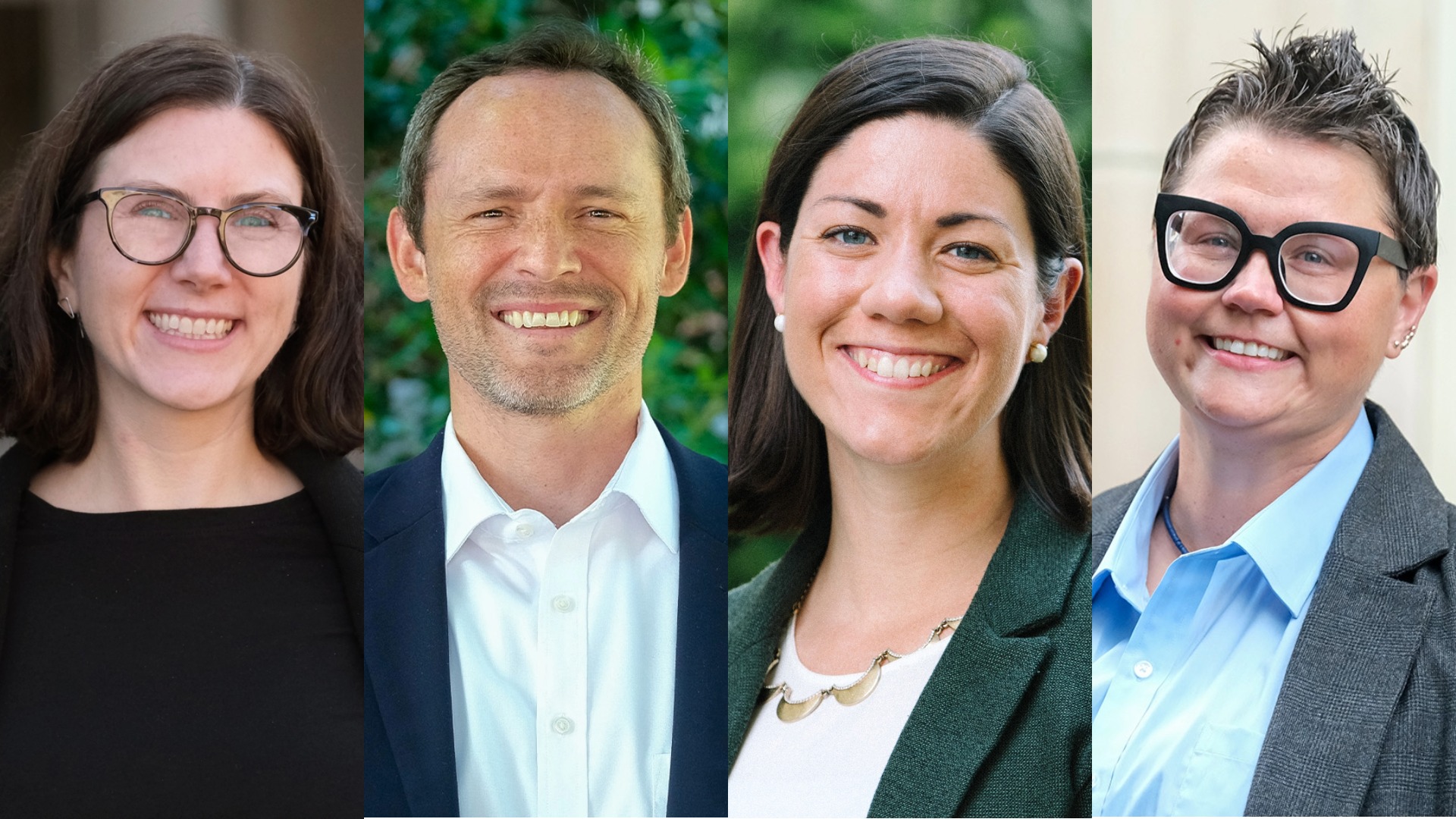
Four UNC School of Education faculty members have been honored with endowed faculty scholar distinctions:
- Courtney Hattan, Ph.D., was named the Donald G. Tarbet Faculty Scholar in Education.
- Todd Jensen, Ph.D., was named the Gary Stuck Faculty Scholar in Education.
- Kathryn Leech, Ph.D., was named the Richard “Dick” Coop Faculty Scholar in Education.
- Stephanie Anne Shelton, Ph.D., was named the Donald G. Tarbet Faculty Scholar in Education.
“These four faculty members are exceptional scholars in their respective fields and deserving recipients of this kind of recognition,” said Jill V. Hamm, dean of the School and William C. Friday Distinguished Professor of Education. “These named faculty scholar distinctions recognize a legacy of research with impact at the School that we are honored to carry on. They also represent our philanthropic supporters’ belief in the School and the impact of forward-thinking education research.”
The faculty scholar distinctions named for Coop and Stuck were made possible by a gift from Malbert Smith III (’77 M.Ed., ’80 Ph.D.) and Alisa Edwards Smith. The Smiths also created the Kinnard “Kin” White Faculty Scholar in Education. The three named distinctions honor the outstanding mentorship Malbert received as a graduate student from then-professors Dick Coop, Gary Stuck, and Kin White.
The Donald G. Tarbet Faculty Scholar in Education honors a former faculty member. The honor was made possible by a gift from the estate of Justeen Tarbet, Tarbet’s wife and a longtime Chapel Hill resident who worked in administrative roles in the community, who died in 2013.
Learn more about each faculty scholar
Courtney Hattan, Ph.D.
Donald G. Tarbet Faculty Scholar in Education
Hattan, an assistant professor and literacy scholar, works to advance literacy instruction by centering students’ backgrounds and knowledge in reading comprehension. Her expertise spans literacy, teacher education, educational psychology, rural communities, and mixed-methods research. Across her research, Hattan contributes to a more expansive science of reading — one that recognizes what students bring to texts as essential to what they understand, remember, and ultimately learn.
Hattan’s expertise, shaped by her experience as a former elementary and middle school language arts and social studies teacher, also focuses on how educators can support students in activating and building background knowledge while reading. Her contributions have been recognized widely, including receiving the International Literacy Association’s 2019 Timothy and Cynthia Shanahan Outstanding Dissertation Award and being named a Reading Hall of Fame Emerging Scholars Fellow.
Her work appears in leading journals such as Review of Educational Research, Reading Research Quarterly, Journal of Educational Psychology, Contemporary Educational Psychology, and Reading and Writing: An Interdisciplinary Journal, as well as practitioner journals such as The Reading Teacher. Hattan also served as guest editor of the December 2024 special issue of Educational Psychologist titled “Expanding the Science of Reading: Contributions from Educational Psychology.”
Todd Jensen, Ph.D.
Gary Stuck Faculty Scholar in Education
Jensen, an assistant professor, specializes in promoting youth development and well-being in the context of family structural transitions, preventing maltreatment among military-connected youth and their families, and strengthening youth-serving systems. Prior to joining the School in 2024, Jensen served as a faculty member at the UNC School of Social Work. He is a Faculty Fellow of the Carolina Population Center, a Fellow of the Society for Social Work and Research, Deputy Editor of the Journal of Family Theory & Review, and an active member of the National Council on Family Relations.
Jensen also serves as director of the Thriving Through Family Transitions Research Lab, a research hub that brings together undergraduate and graduate student research assistants. The lab focuses on identifying factors that promote the well-being of children, youth, and families experiencing family transitions, with particular attention to changes in family structure. Jensen’s scholarship is driven by the proposition that all youth deserve to experience healthy development and well-being across the life course.
Kathryn Leech, Ph.D.
Richard “Dick” Coop Faculty Scholar in Education
Leech, an associate professor, examines early childhood language and literacy development with a particular focus on how children’s social interactions with caregivers support these skills. Specializing in early childhood learning and development, her work sits at the intersection of education and developmental psychology to translate evidence-based practices into strategies that strengthen family functioning and support children’s development.
Leech serves as director of the Early Learning Lab, a collaborative research group of students and professionals whose work draws from human development, psychology, and education. The lab investigates the connections between families, children’s development, and future educational achievement, with an emphasis on producing research that is both rigorous and directly relevant to practice.
Driven by a commitment to ensuring research benefits children and families, Leech’s scholarship employs a mix of quantitative methods and experimental designs to examine how everyday interactions, particularly conversations between parents and children, shape language and cognitive development in early childhood. Leech received a National Science Foundation CAREER Award in 2024 to support research on the role of picture books in promoting parent–child scientific conversation and learning, and in 2025, she was named a recipient of the Phillip and Ruth Hettleman Prizes for Artistic and Scholarly Achievement.
Stephanie Anne Shelton, Ph.D.
Donald G. Tarbet Faculty Scholar in Education
Shelton, an associate professor and qualitative methodologist, specializes in interview- and focus group-based research. Feminist and queer theories regularly inform her scholarship, which examines methodological concepts such as reflexivity, informed consent, bias, and subjectivity. A former K-12 teacher with a commitment to student learning, she also explores pedagogical practices in qualitative inquiry, including how students learn to design and implement qualitative studies that center equity and social justice as core methodological tenets. LGBTQ+ issues in educational settings, particularly within sociopolitically restrictive contexts.
She serves as coordinator of the School’s Graduate Certificate in Qualitative Studies and is currently editor of the Journal of Queer and Trans Studies in Education and the journal Teaching Educational Research Methods. Her work bridges methodological rigor and equity-focused scholarship, emphasizing the role of qualitative research in advancing justice-oriented educational inquiry.
In addition to her research and teaching, Shelton holds several national leadership roles from chairperson of the National Council of Teachers of English’s Genders and Sexualities Equality Alliance, editor of the Journal of Queer and Trans Studies in Education and Teaching Educational Research Methods, series editor for Expanding Approaches to Qualitative Inquiry with Routledge, and secretary of the AERA Qualitative Research Special Interest Group.
About the fellowship namesakes
Richard “Dick” Coop
Dick Coop, Ph.D., former professor of educational psychology, was part of the School faculty from 1968-2004. From 1983-87, he served as associate dean, leading the School’s academic planning and development functions. He also served as coordinator of the Educational Psychology Program. Coop died Dec. 29, 2021.
Before earning a doctoral degree at Indiana University, Coop began his career in education as a high school science teacher and coach in Kentucky. At Carolina, he pursued research interests in learning, achievement, performance, and sport and physical skill development. His teaching and research also focused on the psychology of learning, adolescent and child development, and theories and research in human development and individual differences. He authored or co-authored three academic texts and numerous articles in professional journals.
Coop holds a certification from the Association for the Advancement of Applied Sport Psychology and was a consultant to the UNC-Chapel Hill athletic department, providing trainings in performance enhancement skills to 14 varsity teams.
In addition to scholarly work, Coop published trade books, including “Mind Over Golf,” and was a consultant to Golf magazine.
Gary B. Stuck
Gary B. Stuck, Ed.D., professor emeritus of educational psychology, retired from the School in 2000 after 34 years of service to Carolina. He began his career working as a teacher with the Government of Guam in the early 1960s after earning a baccalaureate degree from Hanover College in Hanover, Indiana. He went on to earn master’s and doctoral degrees from Indiana University and joined the Carolina faculty in 1966.
During his career, Stuck was recognized as an outstanding teacher, receiving the J. Minor Gwynn Undergraduate Teaching Award in 1994. Among his numerous publications, his textbook, “Computers and Effective Instruction,” was nominated for an outstanding book award in 1990.
Stuck worked extensively with public schools in North Carolina and beyond, providing service to more than 75 school districts across the state and working with schools and universities in more than 15 additional states. He also held several offices, including the presidency, in the North Carolina Association for Research in Education.
Donald and Justeen Tarbet
Donald Tarbet, Ed.D., joined the School of Education faculty in 1952 and went on to play a pivotal role in shaping the University’s Summer School. While remaining as a faculty member, he served for 18 years as director of Summer Sessions during a period of significant growth and transformation. Appointed director in 1969, Tarbet led efforts to expand the Summer School beyond its original focus on teacher certificate renewal, opening offerings from across campus to a broader and more diverse group of students.
A native of Missouri, Donald Tarbet grew up on a family farm in Shelby County, the sale of which later provided much of the funding for the Tarbet gift. He graduated from the University of Missouri in 1938, taught for several years, and then served in Europe during World War II. After the war, Tarbet returned to teaching part-time while completing an Ed.D. in school administration at the University of Missouri in 1952. That same year, he and his wife moved to Chapel Hill when he was hired as an assistant professor at the School of Education.
Donald Tarbet died in 1995. At the time, he and Justeen had been married for 54 years. Justeen Tarbet died in January 2013 at the age of 94.