When a county’s children have great educational outcomes, it impacts more than the school system — it benefits the entire community. That’s how Joseph Warren, the Executive Director of Elementary Education, School Improvement, and Federal Programs in Person County Schools, frames the importance of creating the strongest possible foundation for the county’s youngest learners.
One challenge PCS faces, he said, is how to support children in the early learning ages — particularly to help prepare them for kindergarten.
“Since COVID, we’d seen a decrease in some of these foundational skills that our kindergartners need before coming to us, and we needed a way to reach more parents and improve the kindergarten transition, within Pre-K here in our district, but also with private providers and home providers,” Warren said.
UNC and PCS share a deeply rooted educational partnership through the Carolina Community Academy, an innovative K-2 lab school in Roxboro that launched in 2022. This collaboration has created new opportunities for Carolina and its School of Education to better understand the needs of rural communities and develop solutions that can serve similar districts.
The School’s Annemarie Hindman, Ph.D., a longtime literacy expert and researcher, connected with Warren and PCS staff and leaned into a question she thinks gets at the heart of Carolina’s mission:
“I reached out and asked, ‘What do you need, and how can I help?’”
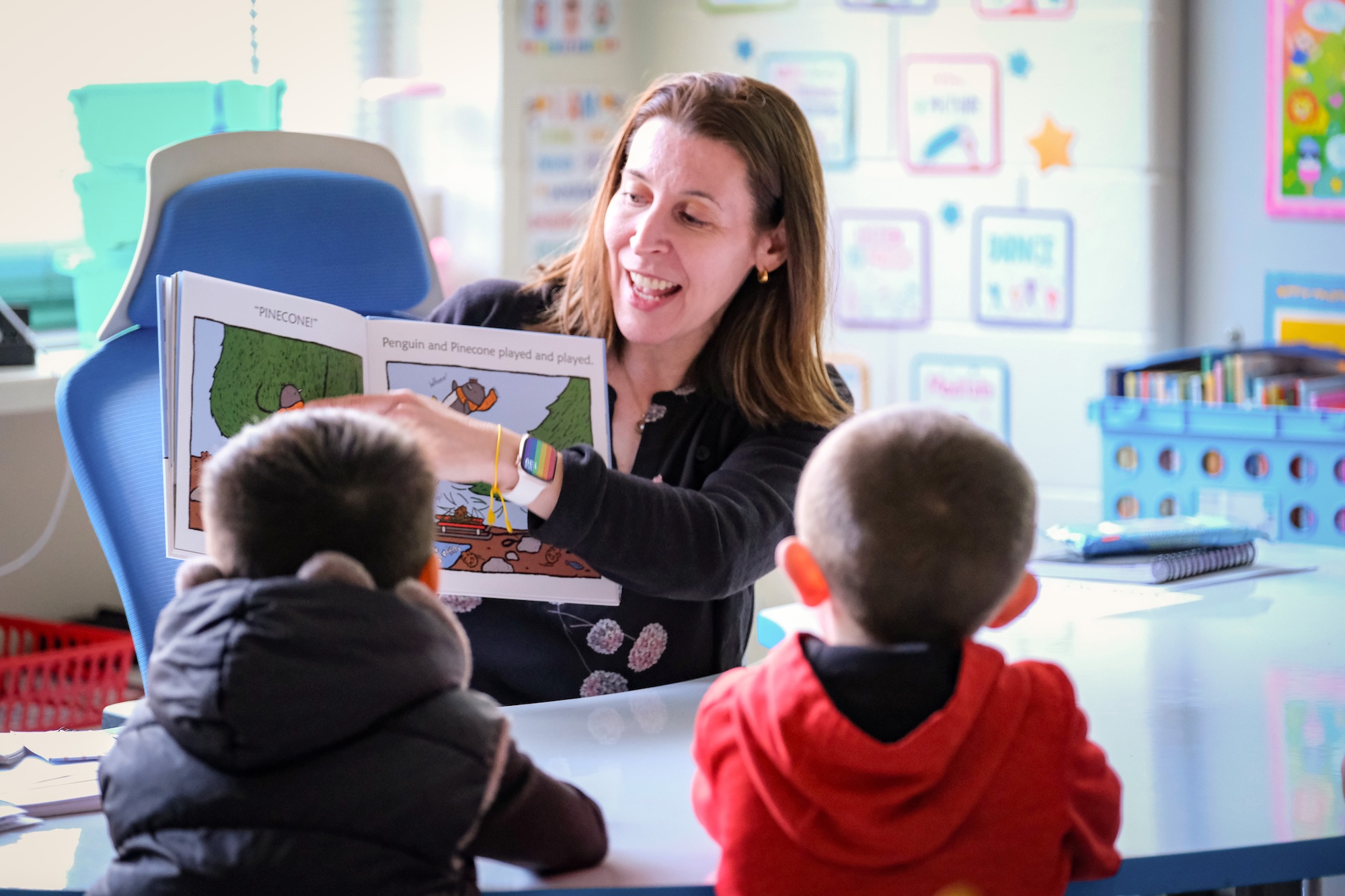
Young children enter school with a wide range of life experiences and early environments that shape their readiness for what is often their first formal classroom, said Hindman, who leads the Carolina READERS (Research in Early Applied Development & Early Reading Skills) Lab. From language development to exposure to numbers, letters, and social-emotional learning lessons, children arrive at the kindergarten classroom along a broad spectrum of preparedness — and they arrive together, in groups, to learn from one teacher.
“Kids are in different developmental places from one another and have very different kinds of experiences to draw on, and the teacher’s job is to work with the group as a whole and to serve each of these kids with very diverse individual needs,” Hindman said. “It can be a lot for a teacher.”
When children start school already fluent in everyday skills — like taking turns and even opening milk cartons — teachers can shift more quickly into the core kindergarten curriculum. Warren said introducing communication and social-emotional skills early, even for children years away from kindergarten, helps prepare them to enter classrooms ready to learn on day one. With those foundational skills in place, teachers can devote more focus to early literacy skills like letters, sounds, and blending.
Hindman partnered with the district to design and conduct a needs assessment around the transition from preschool to kindergarten in PCS and used a combination of interviews, focus groups, and surveys with administrators, teachers, families, and community partners to determine what was truly needed to set up children and teachers for success.
She used that feedback to develop the Transition to Kindergarten Toolkit, a web-based guide to help bridge gaps in readiness with evidence-based, accessible, and easy-to-use tools freely available to all caregivers of young children in Person County, as well as any caregiver or school district who needs resources to prepare children for kindergarten.
Classrooms are busy places! Teachers may take a few minutes to get to each child. You can help your child be more independent by teaching them how to:
- Open and close their food containers (including milk cartons!)
- Manage their coat (zipper, too!)
- Wash their hands
- Use the bathroom by themselves
The toolkit includes helpful information about kindergarten readiness, tips for building language, social skills, and independence, a kindergarten registration guide, videos of read-aloud books, such as the classic Berenstain Bears Go to School, and printable PDFs. It is colorful, easy to use on mobile devices, and includes positive, encouraging, and supportive language about the transition.
While many of the materials work well in print, teachers and family feedback showed that having flexible, interactive information that worked well on mobile devices would be more useful, as most families have and frequently use smartphones and tablets.
In Person County, and in many rural counties, Hindman said, much of the work to support preschool educators in center-based childcare hasn’t necessarily filtered to other care providers, such as family members or home-based caregivers. They typically have less access to the curricula and tools they might need to support young children and their families toward kindergarten readiness. As a result, young children may enter kindergarten less prepared to confidently engage in early learning — to build early literacy skills, grow in their independence, or make friends.
“We went through an iterative process of developing tools, testing them out, and getting feedback so we could build something that is going to work on the ground,” she said. “You can’t do that well without this kind of collaboration. We’ve been very excited to be able to think about this for Person County and build materials that are, hopefully, nicely aligned with what they need and can use.”
“Annemarie’s energy was fantastic, and she brings this wealth of knowledge to early literacy and the kindergarten transition,” said Warren. “To have access to the resources of UNC has been a fantastic support for us. This will help us reach children when they’re still in those really critical ages, and hopefully this can help them from kindergarten all the way up through 12th grade.”
“There were so many great ideas that teachers shared, things they’d wished they could do, but they just didn’t have the resources. But we could make that happen for them,” said Hindman. “I think it is a beneficial and productive way for the School and North Carolina districts to collaborate, for us to say, ‘Here is what we know — what do you need?’ I think this kind of cooperation is really what the University was designed to do.”
Hindman’s Transition to Kindergarten Toolkit was made possible by private philanthropy and an award from UNC Rural’s Rural Research Engagement and Advancement Fund.