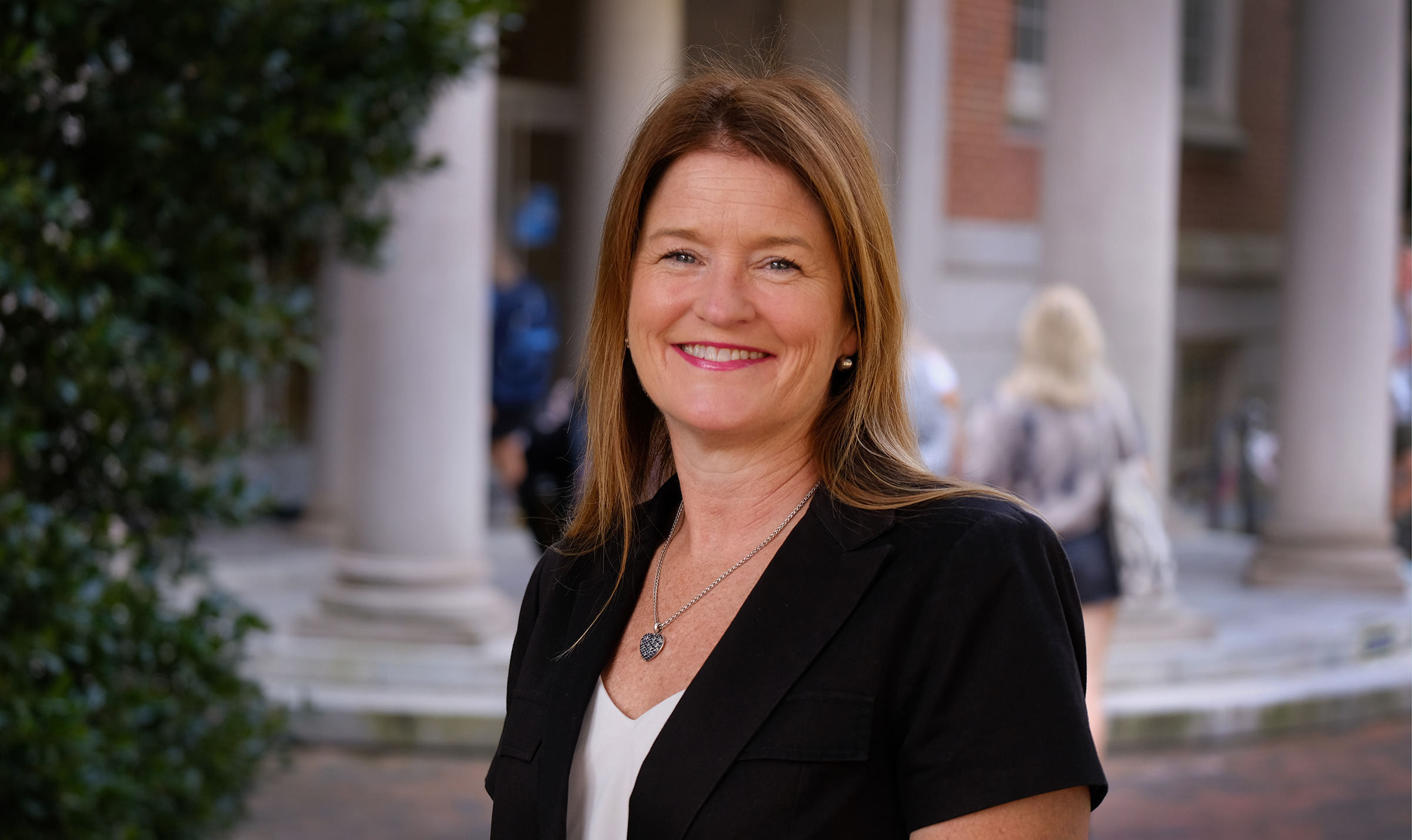
Dorothy L. Espelage, Ph.D., William C. Friday Distinguished Professor of Education at the UNC School of Education, has been named a recipient of the 2026 Robert E. Bryan Public Service Award in recognition of her community-centered work to strengthen youth well-being across North Carolina. The award was presented April 9, 2026, during the 27th annual Public Service Awards ceremony, hosted by the Carolina Center for Public Service at the Sonja Haynes Stone Center for Black Culture and History.
The Robert E. Bryan Public Service Award honors individuals and groups whose work reflects meaningful service to North Carolina through community partnership, practical impact, and lasting benefit. Espelage was recognized for her leadership and mentorship in initiatives including Sources of Strength and the Research Addressing Violence in Education Lab, as well as for her broader contributions to youth mental health, school safety, and violence prevention.
A nationally and internationally recognized scholar, Espelage conducts research that informs prevention and intervention efforts that better support children, adolescents, educators, and families. Her work focuses on bullying prevention, teen dating violence, sexual harassment and violence, school-based suicide prevention, and social-emotional learning interventions. Over three decades, she has worked with school districts, families, and community organizations to help prevent school violence and promote positive school climates. She has also secured more than $50 million in external funding and has advised policymakers and supported research dissemination for national organizations and agencies.
Since joining Carolina in 2019, Espelage has expanded that work through partnerships that connect research, practice, and public service by collaborating with undergraduate students and the Sources of Strength leadership class to share messages of connectedness and help-seeking across campus. That work helped lay the foundation for broader collaboration across North Carolina’s 100 counties through partnerships with the Suicide Prevention Institute to implement Sources of Strength statewide.
More recently, Espelage’s work has advanced through a $16 million Patient-Centered Outcomes Research Institute (PCORI) study to reduce adolescent suicide-related risk, in collaboration with Marisa E. Marraccini, Ph.D., the UNC School of Education’s Donald and Justeen Tarbet Faculty Scholar in Education. The project supports partnerships in Ohio, Idaho, Washington, and North Carolina to evaluate two evidence-based suicide prevention programs. As part of the study, the programs will be implemented in 20 North Carolina schools, with a focus on eighth-, ninth-, and 10th-grade students to identify approaches that reduce suicidal behaviors, promote positive school climates, and improve academic achievement.
Espelage also continues to lead and contribute to funded research projects, including School Environment as a Social Driver of Youth Mental Health Trajectories in Mwanza, Tanzania through the National Institute of Mental Health; A Community-Driven Modeling Approach for Identifying Community- and Policy-Level Interventions to Address the Impact of Structural Racism and Discrimination on Adolescent Substance Use and Mental Health through George Washington University; and Impact of Disability Anti-Bullying Training for Elementary Special and General Education Teachers (Project DIAL): Impact on Teacher Awareness and Self-Efficacy and Student Outcomes through the University of Missouri.
“I am honored to have received the 2026 Robert E. Bryan Public Service Award for my three decades of working with school districts, teachers, students, and families across the U.S. and North Carolina,” Espelage said. “This work is challenging, but it is equally rewarding. My research is only possible because of the willingness of communities to open their doors and hearts to my team of undergraduate and graduate students over the last three decades. I am hopeful that we will continue in the academy to value this community-engaged scholarship and policy work.”