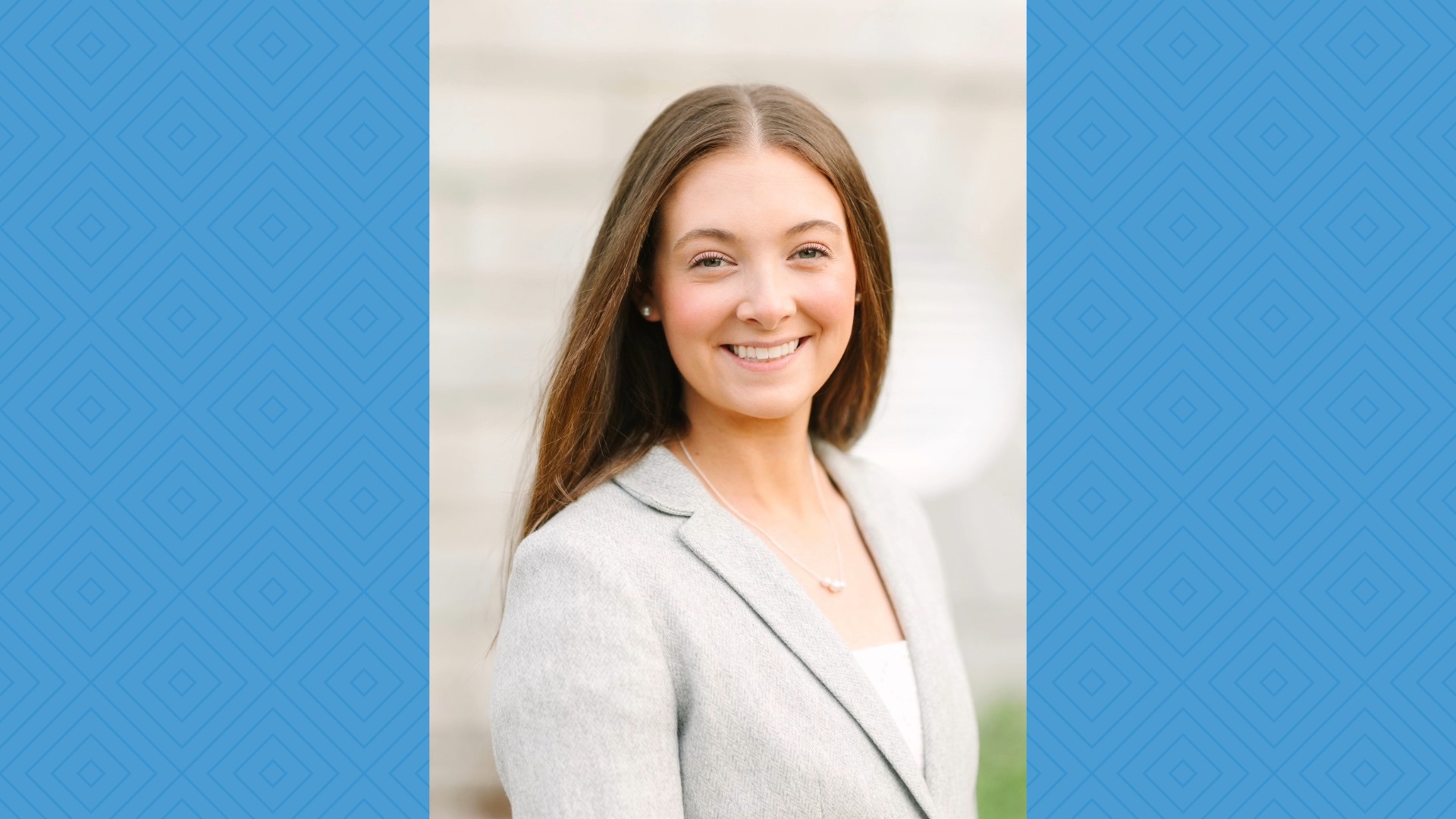
For Isabella Ruel, the questions that now guide her research began close to home.
School was always a place where Ruel felt confident and connected to learning, but as she grew older, she recognized that not every child shared that same experience.
“I saw it firsthand with my two younger siblings who had similar opportunities and school experiences I did, but they struggled in reading and writing,” Ruel said. “It really affected their overall experiences with school and learning.”
That realization sparked Ruel’s interest in children’s learning and development, especially the role language and literacy play in helping children make sense of the world. As a doctoral student in the Applied Developmental Science and Special Education concentration of the UNC School of Education’s Ph.D. program, she is examining how caregiver language interactions can support young children’s reasoning and science learning.
“We know that [language interaction] helps children bridge gaps between the words on a page and actually understand what’s going on in the story,” Ruel said. “But we don’t know as much about how that type of language can impact children’s thinking about the world more broadly, specifically as it relates to science learning.”
Ruel is an awardee of the National Science Foundation Graduate Research Fellowship, one of the most prestigious fellowship programs in the United States. Established in 1952, the NSF Graduate Research Fellowship Program recognizes and supports outstanding graduate students pursuing full-time, research-based master’s and doctoral degrees in STEM and STEM education fields. The fellowship will support Ruel’s work examining caregivers’ inferential talk, language that encourages children to explain, reason, and predict beyond what is directly visible.
Connecting language, literacy, and science learning
Before coming to Carolina, Ruel, who earned her Bachelor of Arts in psychology with minors in education and neuroscience from the College of the Holy Cross in 2025, explored children’s learning through undergraduate research on informal science learning in museum settings. Working with her advisors, she conducted an independent project examining how guided comparisons could help children learn about the day-night cycle.
The work brought her into museum spaces on weekends, where she collected data and interacted with families and children. Those experiences helped her see research as a way to understand how learning happens in real time.
“My core interest is really in understanding and supporting parents through language and literacy practices and seeing how that affects children’s thinking and reasoning more broadly,” Ruel said.
Drawn to the School’s interdisciplinary research community, Ruel saw an opportunity to connect that background with her interest in literacy and early learning.
“One of my favorite parts about the School of Education is that all of the researchers and professors come from completely different backgrounds,” Ruel said. “I liked the idea of working with people who use a variety of different methodologies and perspectives, but all have similar goals in supporting learning.”
Ruel was also drawn to the opportunity to work with Kathryn Leech, Ph.D., Richard “Dick” Coop Faculty Scholar in Education, whose research examines caregiver language interactions and early STEM learning. Through Leech’s NSF-funded project, Ruel began studying the language caregivers use while reading science-themed books with children, work that shaped the foundation of her fellowship proposal.
In her preliminary research, Ruel became interested in the kinds of questions caregivers ask children while reading, especially those that invite children to explain, reason, or predict beyond what is visible on the page. As noted by Ruel, questions such as “Why do you think that?” or “What could have caused that?” may help children connect ideas and deepen understanding.
“Promoting school readiness can be challenging because a lot of times the differences we see in children are rooted in disparities that are hard to combat,” Ruel said. “But the way we talk to children in our everyday lives — in the car, at the dinner table, while reading books before bed — is something that I think every family can easily integrate to support their children. I think it’s an exciting area to learn more about because it can have big impacts in the way that parents can support their children’s development in a simple way that they already do every day.”
Finding her voice as a scholar
For Ruel, the NSF fellowship will provide the time and autonomy to pursue a long-term research agenda. The fellowship spans five years, with three years of funding, and Ruel said she plans to begin her fellowship-supported work in her third year after gaining teaching and research experience.
“I’m interested in the ways language interactions shape how children think about the world and reason about the world,” Ruel said. “Caregivers play such an important role in those early learning moments. Through this research, I hope to better understand how those interactions can support children’s curiosity, confidence, and development.”
Ruel is also a contributing member of the Early Learning Lab led by Leech. In the lab, she has examined the types of questions parents ask children during book reading, how children respond, and how those interactions may connect to children’s later performance on a science inquiry measure. The project has also enabled Ruel to mentor undergraduate lab members, helping them gain research experience while contributing to the study.
“My work with Katie has definitely been the greatest contribution to my development as a researcher,” Ruel said. “She’s given me a lot of support, but also a lot of independence in becoming more confident in myself as a researcher. She has helped me ask research questions that truly interest me and that I think are meaningful.”
As she continues her doctoral journey, Ruel hopes to stay in academia, balancing research and teaching throughout her career. Her work remains guided by a broader question: How can the ways adults talk, read, and wonder with children help them grow into confident thinkers?
“Learning how to promote conversations that help children feel more confident and more capable in science learning from an early age is something that excites me,” Ruel said. “A lot of children’s early experiences shape how they experience science throughout their academic careers. I hope this work can help us better understand how to support that learning from the beginning.”