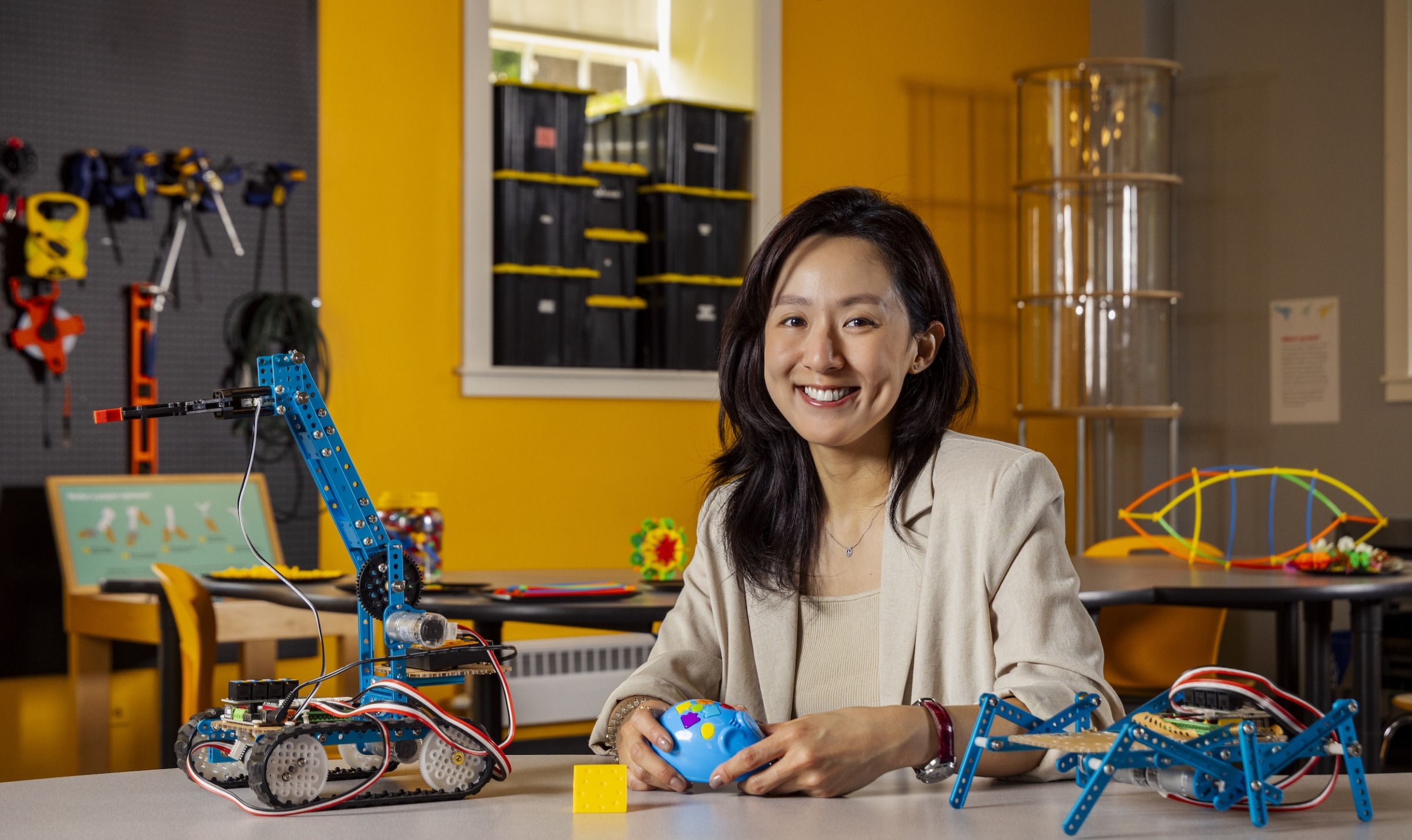
Slki Lim is a former postdoctoral researcher and Ph.D. alumna at the UNC School of Education. Starting in June 2026, she became an assistant professor at Georgia Southern University. Her research explores how students engage with STEM learning through conversations, gestures, emotions, movement, playful action, and interactions with technology.
How did you discover your specific field of study?
I discovered my field through a long-standing curiosity about how people learn in ways that are not always visible on the surface. Early in my research, I studied computational thinking and how young learners made sense of ideas through robotics, hands-on activities, and multiple forms of representation. That work continues to shape my research today.
Over time, I became especially interested in learning moments in which students are not simply giving correct answers but are exploring, gesturing, talking, building, testing, moving, and trying again. This led me to study STEM learning across both formal and informal settings, including classrooms, robotics activities, and museum-based science learning. My current work focuses on how students engage with STEM ideas through talk, movement, emotion, playful action, and technology-enhanced experiences.
Academics are problem-solvers. Describe a research challenge you’ve faced and how you overcame it.
Studying learning in environments that are lively, messy, and unpredictable. Whether students are working with robotics materials or exploring a museum exhibit, they are often moving around, talking with peers, touching objects, using technologies, shifting attention, and trying different strategies. That makes the data rich, but also difficult to analyze in a clear and systematic way.
To address this, I developed a structured approach to examine the data without losing the complexity of the experience. For example, in one project, I analyzed students’ science-related talk together with their gestures and visible behaviors. I used coding frameworks to identify patterns, but I also returned to the actual video moments to understand what those patterns meant in context. This helped me move beyond simply counting behaviors and toward explaining how students’ engagement unfolded over time.
Describe your research in five words.
Finding learning in playful action.
Who or what inspires you? Why?
I am inspired by students’ small moments of curiosity. Sometimes learning does not look like a polished explanation or a single correct answer. It can look like a student pointing at something, asking a peer a question, moving their body to show an idea, testing a robot, trying a task in new ways, or connecting an activity to something they have seen before.
Those moments inspire me because they remind me that learning is human, social, embodied, and often unfinished. I am especially interested in creating and studying STEM learning environments where students can explore ideas through tangible, playful, and meaningful actions. My work is motivated by the hope that more learners can experience STEM as something accessible, creative, and connected to their lives.
If you could pursue any other career, what would it be and why?
A museum exhibit designer, educational media producer, or learning experience designer. Whether through an exhibit, a robotics activity, a short film, a game, an interactive installation, or a digital tool, I would want to design learning experiences that invite people to ask questions, explore ideas, and feel that they belong in STEM spaces.
This story was originally published by UNC Research. To read the original article and discover more Carolina research stories, visit the UNC Research website.