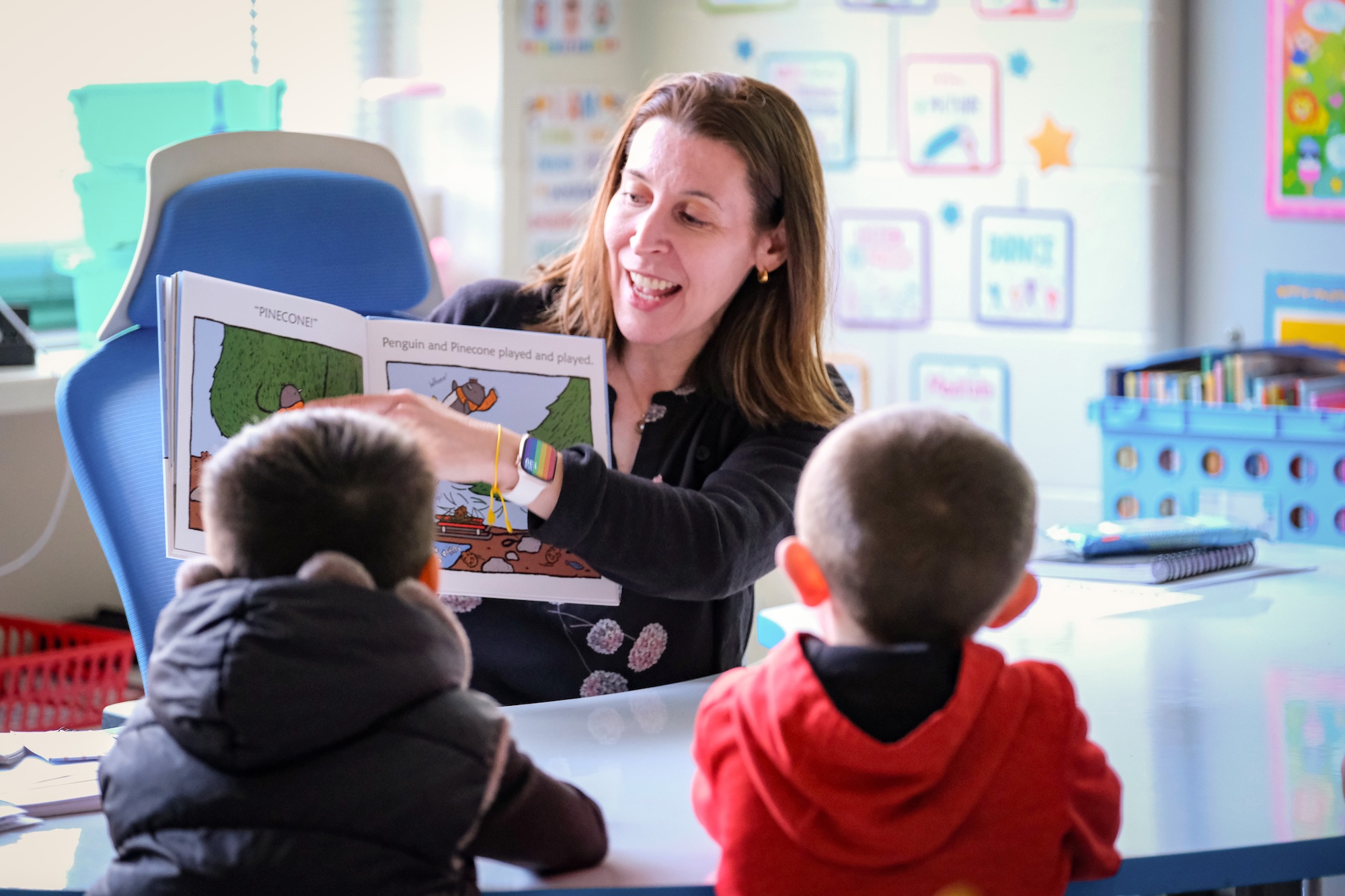
As children prepare for their first K–12 classroom, many families focus on learning the alphabet, counting to 20, or recognizing colors and shapes. While those foundational skills certainly matter, UNC School of Education faculty member Annemarie Hindman, Ph.D., says some of the most important kindergarten readiness skills look different — going beyond the classroom to help kids have positive interactions with teachers and classmates.
Children benefit from knowing how to communicate their needs, interact with peers, follow routines, and complete everyday tasks independently. These skills can help children feel more confident as they enter kindergarten and give teachers more opportunities to focus on learning and instruction.
“Being ready for kindergarten ranges from being able to explain what you need to knowing how to open your own milk carton,” Hindman says. “Some of the most important things you can do revolve around helping kids navigate life in a classroom.”
According to Hindman, who leads the Carolina READERS (Research in Early Applied Development & Early Reading Skills) Lab, there are five key ways families and caregivers can help children prepare for kindergarten:
- Talk with your child
- Read books with your child
- Teach the basics
- Build social skills and independence
- Get ready to move
These recommendations form the foundation of the Transition to Kindergarten Toolkit, an evidence-based resource Hindman developed in partnership with Person County Schools to help families, childcare providers, and other caregivers support young learners before they enter the classroom.
Hindman says that in Person County — and in many rural communities — the resources and professional development available to educators in center-based childcare settings do not always reach other caregivers, such as grandparents, family members, or home-based providers. Throughout North Carolina, and especially in rural areas with fewer childcare centers, most children spend their days with these caregivers, making them an important part of getting children ready for kindergarten. As a result, many of the adults helping prepare young children for kindergarten may have less access to the tools and strategies that support early learning.
To help fill that gap, Hindman worked closely with educators and childcare providers across Person County to develop a practical, research-informed resource that families and caregivers can use in their everyday interactions with children. While the toolkit was designed with the needs of Person County families in mind, Hindman says the strategies can benefit anyone looking to help children build a strong foundation before kindergarten.
Talk with your child
Conversations help children build vocabulary, strengthen communication skills, and learn how to express their thoughts and needs — skills they’ll use every day in a kindergarten classroom.
Research has consistently found that the quantity and quality of language children hear in their early years play an important role in vocabulary development and later reading success. For example, hearing more language and participating in more conversations helps children’s brains process language in more effective ways (Romeo et al., 2017). Hindman says those opportunities don’t require special lessons or activities.“There are so many ways to talk with a child that will bolster their kindergarten readiness,” Hindman says. “Talk to your child at any and all points during your day and give them space to respond using their own voice.”
What parents can do
- Describe what you’re doing
If you’re cooking or baking, one example would be to say, “Now I’m getting out my measuring cup so I know exactly how much flour I am adding.” - Describe what your child does
If you’re heading out of the house to go to the store or to the park, you can say, “You’re putting your shoes on, and you’re tying those pretty white laces in a tight bow!” - Use big words with little kids
Don’t be afraid to use big words! For example, you can say, “Let’s examine this rock,” instead of saying, “Let’s look at this rock.” - Ask your child open-ended questions
Don’t just ask yes or no questions. Give kids the opportunity to respond to questions with many different right answers. You can do that by saying:- “Tell me…”
- “Describe…”
- “How…?” and
- “Why…?”
Read books with your child
Reading together builds early literacy skills, but it also creates opportunities for conversation, vocabulary growth, listening, and critical thinking. In fact, children whose families read with them more often experience long-term gains in vocabulary and other language skills (Demir-Lira et al., 2019).
“The goal isn’t just to get through the story,” Hindman says. “It’s to talk, wonder, ask questions, and help children make connections to the world around them.”
What parents can do
- Learn about your child’s interests
Take your child to the library or bookstore and choose books with them. Keep an eye out for new books they might like. - Talk about the book’s cover
Before you even open the book, the cover provides opportunities to engage children. Ask your child to describe what they see and what they think the story might be about. - Ask for your child’s opinion
Ask your child, “What do you think the character is feeling?” or “What would you do if you were the character?” Then ask, “Tell me why!”
Teach the basics
While kindergarten readiness extends beyond academics, children do benefit from entering school with basic familiarity with letters, numbers, shapes, and colors.
For example, a classic report from the National Early Literacy Panel in 2008 reviewed hundreds of studies and found that, when children knew more letters, they went on to develop stronger decoding skills, reading comprehension, and spelling.
“The ABCs and 123s are classics for a reason,” Hindman says. “They are foundational for basic academic learning in kindergarten.”
What parents can do
Look for opportunities to practice foundational skills in everyday life — not just during dedicated learning time. Parents can practice counting while grocery shopping, identifying shapes during walks, or playing simple alphabet games throughout the day.
Children should begin developing familiarity with:
- Uppercase and lowercase letters of the alphabet
- The sounds letters make
- Counting numbers 0 to 20
- Quantity (for example, knowing that 10 is more than 5)
- Basic shapes
- Basic colors
Build social skills and independence
Many families focus on academic preparation before kindergarten, but social-emotional skills are equally important.
Children entering a classroom must learn how to share materials, work alongside peers, navigate disagreements, and communicate with adults they may not know well. In North Carolina, kindergarten classrooms are expected to serve at least 18 students, all of whom spend the day working and playing together mostly in one space.
“Being in a classroom with other children or with a new adult can be difficult, but the more you can introduce social skills at home or in daycare, the better the chances of a smooth transition,” Hindman says.
What parents can do
- Share space and materials
Giving your child opportunities to practice sharing with friends or family is such an important social skill. Even if you don’t have other children at home, you can take turns using markers or crayons with your child. Another great activity is building together with blocks. - Solve disagreements
Help your child practice explaining what they want, listening to what a friend wants, and then reaching a compromise or agreement. - Use the bathroom independently
Help your child practice using the bathroom, including managing their clothes and washing and drying their hands. - Classroom self-care skills
Kindergarten teachers often spend a good amount of time helping kids take their jacket on and off or teaching them how to use a zipper. Add in teaching kids how to put on or tie their shoes and how to open snack, lunch, or drink containers, and that can take up a lot of time in a day. Teaching your children these essentials can provide teachers with more time for academic instruction. - Asking for help
Let your child practice asking politely for help when they need it, so that they can advocate for themselves in the kindergarten classroom.
Get ready to move
Children also benefit from developing the fine and gross motor skills they’ll use throughout the school day. From holding a pencil and cutting with scissors to zipping a jacket, climbing on the playground, or sitting comfortably during classroom activities, movement plays an important role in children’s ability to participate and learn.
For example, early learners who start the year with stronger motor skills tend to build more self-control and interpersonal social skills over time (MacDonald et al., 2016). Hindman says, “Many of the motor skills children need for kindergarten can be developed through play and everyday activities.”
What parents can do
- Get a grip
Help your child practice comfortably gripping different types of writing tools, such as a pencil, pen, marker, and crayon. - Write on!
Help your child use a pencil to form letters, numbers, and shapes. Help them write their own name and learn to recognize it. - Zip it up
Work with your child on using zippers, large and small buttons, snaps, and shoe closures like Velcro or laces. - Making moves
Encourage your child to move their whole body by running, jumping, and skipping, as well as throwing, catching, and kicking. - Hit the playground
Playgrounds offer your child the chance to move in new ways. Invite your child to climb, hang, swing, and crawl on large play structures.
To view the full toolkit or to share with parents of soon-to-be kindergartners, visit the Carolina READERS website.