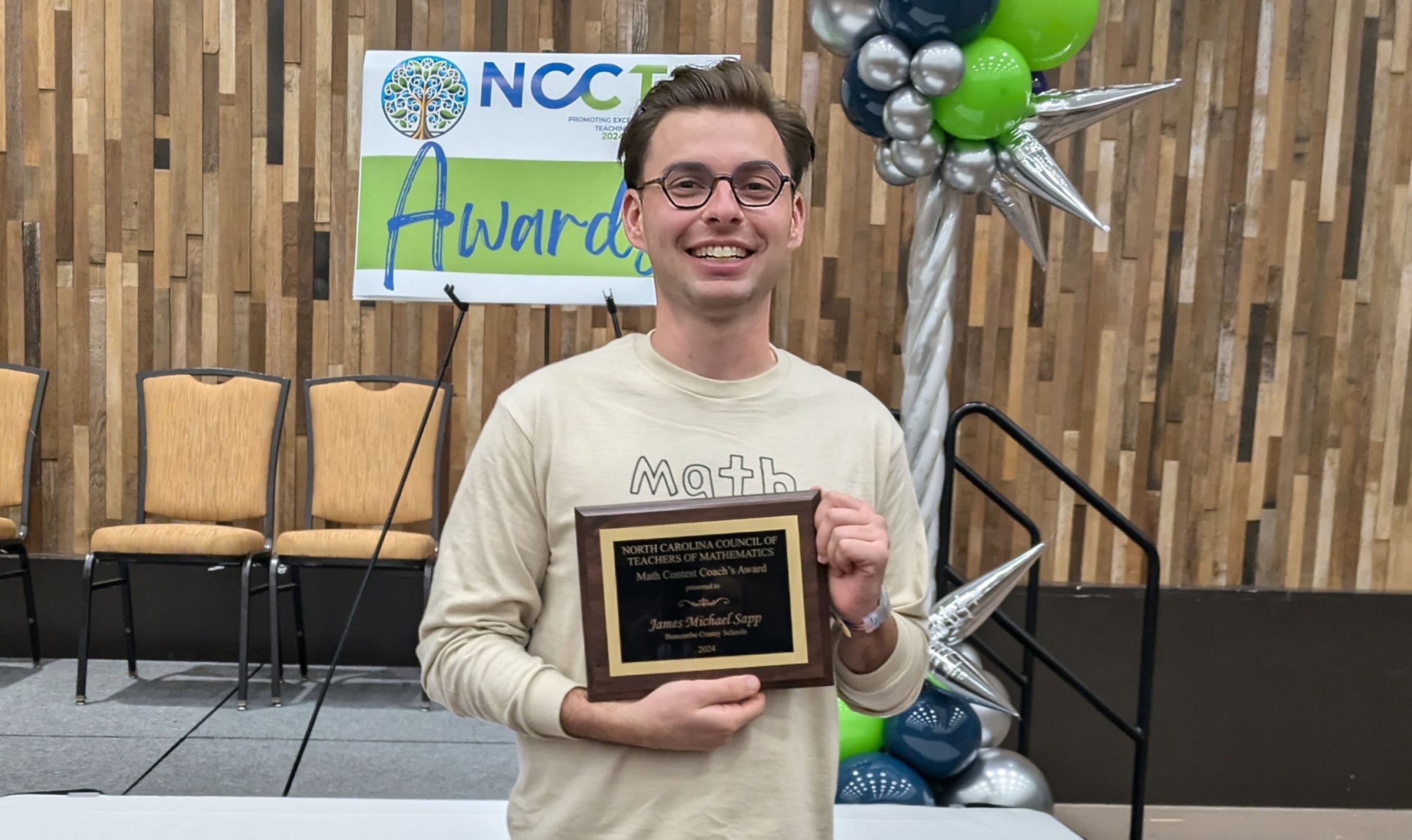
In 2021, UNC School of Education alumnus James Michael Sapp (’21 M.A.T.) was named North Carolina Association for Colleges of Teacher Educators’ Student Teacher of the Year, an award that recognizes the most outstanding candidate completing their clinical teaching practice.
Five years later, he is preparing to step into his first assistant principal role.
The path between those milestones has included four years teaching mathematics and social studies at Owen Middle School in Buncombe County, recognition as the district’s Secondary Math Teacher of the Year, graduate study in school administration, and a growing desire to expand his impact beyond a single classroom.
But when Sapp reflects on his first years in education, awards and titles are not what come to mind.
“What I think about most is the relationships with the students that I formed,” he said. “I can remember every kid’s face from day one.”
For Sapp, teaching was never a career he stumbled into. It was a calling he briefly tried to ignore. After earning his undergraduate degree in history from Carolina, he took a year to explore another professional path. The experience quickly confirmed what he already knew.
“I haven’t questioned one day since then whether or not education was for me,” he said.
That calling brought him back to Chapel Hill and the School’s Master of Arts in Teaching (MAT) program, where he said his preparation changed the way he experienced his first years leading his own classroom. Like many beginning teachers, he was still learning, adapting, and finding his voice. But rather than spending those years learning classroom fundamentals, Sapp said the MAT program made it possible for him to focus on refining his practice and growing as an educator.
“I wasn’t figuring out how to teach,” he said. “I was figuring out how to be a better teacher.”
In his classroom, Sapp expected students to read, write, move, speak, and collaborate every day — even in math. He believed learning should be active, that students should be known, and that every child should have opportunities to contribute.
“It was my job to get students to speak every single day,” he said.
At first, that approach surprised students who came into math expecting a more traditional classroom experience, in which teachers speak and students listen.
“When kids would come into my math classroom, they’re like, ‘What are we doing? Why are we writing so much? Why are we speaking so much?” Sapp said.
But for Sapp, those routines were central to how students learned and how relationships formed. He worked to meet students where they were, adapting instruction and creating opportunities for them to connect with content, with him, and with one another. Just as importantly, he learned that holding students to high standards and building strong relationships were not competing goals.
“As a beginning teacher, you’re trying to find your teacher voice,” he said. “I feel like I’ve finally found that voice.”
Sapp taught briefly in Chatham County after graduation before accepting a teaching role in Western North Carolina, where he grew up.
Returning to Buncombe County provided him the opportunity to teach in a community he already knew and loved while deepening his understanding of how schools can strengthen communities.
“The respect that the community gives around here — you can feel it,” he said. “A love for the schools, for the parents involved in them. I think that’s special.”
The relationships he built with students soon extended beyond school walls.
“I have positive relationships if I bump into them in the grocery store or I see their parents,” he said. “The fact that I built relationships with these students in a classroom that spread throughout this community that I’m in — that stands out the most.”
Sapp’s father taught for more than 40 years, offering an example of what it means to dedicate a career to students and a community.
“I’ve so valued that my father was somebody that taught in the same school for so long and what that meant for the community,” Sapp said. “But I want to take that same love and passion and expand it to a larger scale.”
Now, as he moves into Henderson County, he sees his sense of home expanding across Western North Carolina. With that expansion comes a growing vision for leadership. Sapp said he sees school leadership as a way to broaden the kind of impact he hoped to make as a classroom teacher.
While in his fourth year of teaching, Sapp began the Master of School Administration program at Western Carolina University, where he was a Principal Fellow. He later completed administrative internships at an elementary school and an intermediate school, experiences that helped prepare him for his new role as assistant principal at Apple Valley Middle School in Hendersonville.
He’s continuing educational leadership journey by pursuing an Ed.D. with an interest in improving educational outcomes and examining discrepancies in math proficiency among students and student subgroups.
The work ahead is still taking shape, but Sapp’s purpose remains clear. He hopes to continue serving as a leader — in schools and in education more broadly. For now, he is focused on the same purpose that first brought him to teaching and sustained him through his first five years in education.
“The kids keep showing up,” Sapp said. “And it helps me show up.”