In a high-school hallway, one student posts a photo to her social media feed and watches with anticipation as she waits for likes and comments to start rolling in.
Online peers in this teen’s network may engage with the post in different ways — by clicking “like,” or by simply taking note of the post’s content before continuing to scroll through their newsfeeds.
For every social media user in this scenario, feedback received from online peers can elicit a range of emotions that are driven by a fundamental need to belong and feel valued by others. Teens who don’t receive as much positive feedback on social media may be stuck wondering why, and their self-worth may be negatively impacted, even slightly.
Given the prevalence of smartphones and the near-constant access to social media, even during the school day, these effects may have a greater impact than we know.
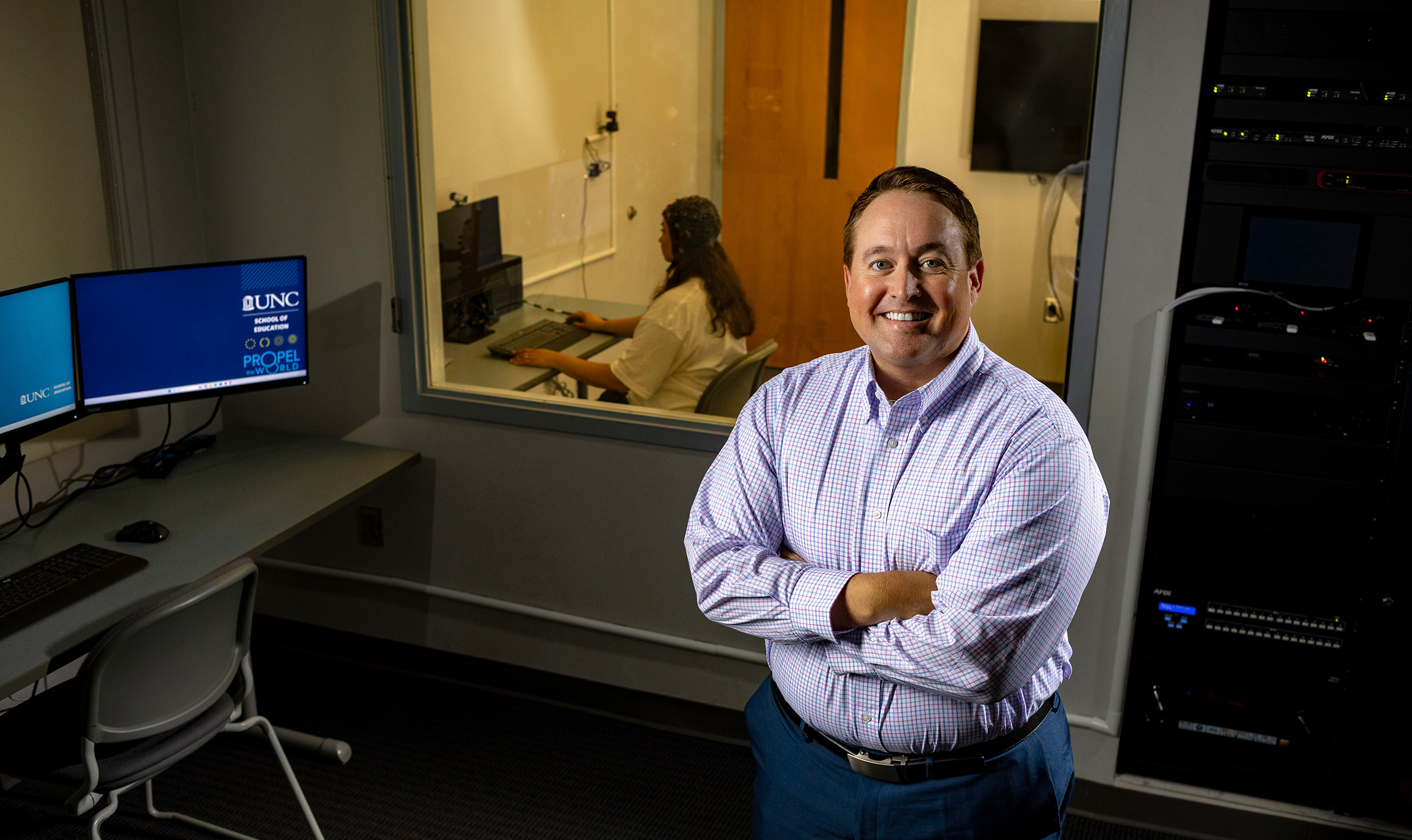
“Clinicians aren’t asking enough about teen social media use, even though it’s a key contributor to teen mental health,” says Casey Calhoun, Ph.D., a clinical psychologist and assistant professor at the UNC School of Education, who has spent years studying stress and coping in adolescents.
The developmental transition into adolescence is already a heavy lift for the body, and it’s a time when young people are particularly vulnerable to social feedback in all its forms, says Calhoun. Social media exposes this age group to endless opportunities for social feedback and social comparison, which could add to stress and increase risk for mental health disorders like depression and anxiety.
“Social media is filling the void where other coping processes or healthy experiences of boredom used to take place,” says Calhoun. “As a clinician, it’s an important piece of understanding how people cope — how much does social media use interfere with or negatively impact coping?”
Calhoun says we don’t really know enough about the psychological and neurobiological mechanisms underlying that impact. How does online social feedback and social comparison affect the brain and body? Who is most vulnerable and how can we best support them?
Calhoun’s new study of a social-media-like experiment, called the Likely Study, will attempt to answer these questions. Calhoun hopes the findings will empower teens and young adults to navigate social media in healthier ways — and eventually guide future research and policy focused on minimizing the negative impacts of social media for those who are most vulnerable.
The problem with frequent social feedback
Our brains are hardwired to seek out social relationships and to use social feedback to help guide our decision-making and perceptions of self, but interpersonal experiences can also be a significant source of stress, Calhoun says.
The systems in the body involved in responding to social cues ramp up during adolescence, right around the same time the body is developing new ways of responding to, or coping with, stressors. So, teens and young adults are much more sensitive and responsive to social feedback, but they may not possess the ability to regulate emotions prompted by this feedback.
“Before social media, we mostly received feedback and engaged in social interactions when we were physically present with other people,” he says. “With social media, social feedback can feel ever-present, even if we’re alone. When you have social media in your pocket, the biological systems that respond to social feedback are being constantly tapped into, over and over again, throughout the day. It’s constant and pervasive social feedback.”
How the digital social comparison offered by social media affects stress response systems is essential for understanding how this process translates into risk for developing depression and anxiety.
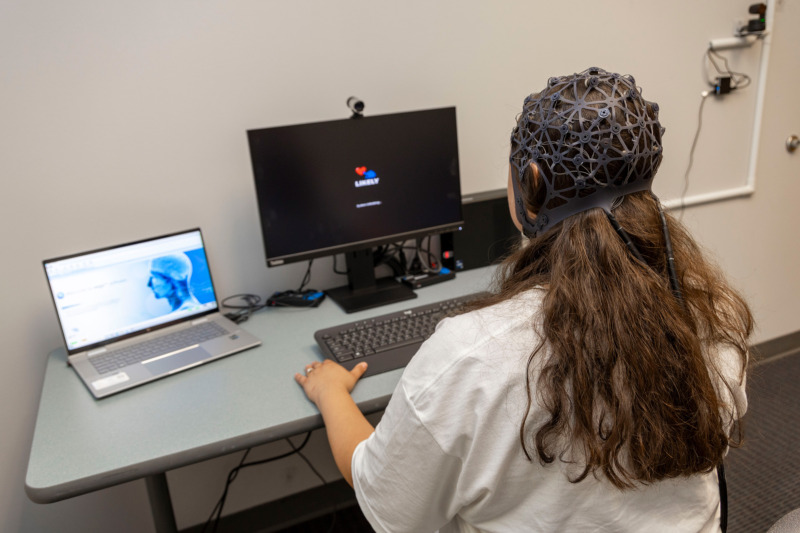
This is why Calhoun developed the study — to simulate digital social comparison and assess its effects on stress response systems to capture how passive consumption of social media affects different systems involved in processing social information.
Participants will create profiles in an electronic system designed to mimic a social media platform and both receive and offer feedback in a simulated environment. Calhoun and his team are using a variety of biomarkers to measure stress responses during social media use. They are using electroencephalogram (EEG) tests to measure electrical activity in the regions of the brain tied to interpersonal stress and reward processing. They will then determine how these neural patterns connect with downstream hormone systems that produce cortisol and oxytocin and prompt physiological reactions such as heart rate and skin conductivity. With the assistance of collaborator James Crowley, Ph.D., from the UNC Department of Genetics, Calhoun’s team will also collect genetic information as well as stress responses to digital social feedback to be linked with specific genetic dispositions.
“We’ll be able to see how digital experiences can get under the skin and connect with stress responses and social information processing across multiple systems.”
Calhoun’s team hopes to understand how this can add up in the body to create profiles of risk and resilience that the body might exhibit during passive consumption of social media.
Calhoun has been studying cortisol and the HPA axis for a decade, and he says it’s shown him that looking at just one system isn’t enough — how one system operates alongside other systems tells a much more complete story about risk and resilience. His prior work has shown that people with similar levels of functioning in one system can have very different levels of risk based on the functioning of their other systems.
“The goal of this task is to allow for simultaneous examination of responses across multiple systems that are more central to processing social information, so that we can establish more integrated, holistic profiles of risk and resilience.”
Translating research to practice
While Calhoun enjoys lab-based research, he is also passionate about sharing evidence-based information with the public, particularly in service of supporting youth. He aims to combine findings from the Likely Study with the broader research literature in translational projects that will have a more immediate impact on youth well-being.
Calhoun is building on his prior work in mobile applications by developing a new app to support teen well-being. Many teens who are at risk for developing depression or anxiety do not have easy access to mental health services and may be stuck trying to figure things out on their own. Calhoun hopes to meet teens where they are by delivering evidence-based information directly to teens and empowering them with knowledge that could help guide them in their journey through adolescence and into young adulthood.
“I’d like to develop an evidence-based tool for teens that is entertaining, engaging, and interactive in ways that keep them coming back for more,” he says. “I want to support teens in guided self-reflection as they are figuring out who they are and what they want for themselves. I’d like to help them pause and think, ‘is this making things more difficult for me, or is it helping?’ And if something isn’t going according to plan, ‘what next steps can I take?’”
A tool, like Calhoun’s app, could be a balancing force in the experience of social media stress, helping to combat the negative repercussions of near constant exposure to social information.
“It’s easier to see the impact of larger negative experiences, but the smaller moments of social comparison that ding your self-esteem are subtle. Those dents add up over time and amplify risk, which is what we want to prevent with this app. Without competing digital platforms that support teens in revealing their personal strengths and successes, teens may struggle with self-appreciation and feel discouraged from pursuing things that are meaningful to them.”
Helping teens help themselves
The big picture is not about telling teens what to do, says Calhoun, or suggesting parents keep them off social media entirely. Those approaches aren’t realistic, nor are they likely to be effective. Teens use social media for connection, which is important. But parents and teens need to be aware of the risks that come with social media use so they can make informed decisions. What teens and parents need is more evidence-based information, as noted by Calhoun, and the Likely Study and mobile well-being app for teens seek to provide it in different ways.
“Teenagers don’t like being told what to do,” Calhoun says. “But we can empower them with information to guide their decision-making. Without good information and calm moments of personal reflection, teens are more likely to base their decisions on what they feel in the moment and what their preexisting social programming tells them to do.”
Adolescence is a time of chaos — biologically, socially, and psychologically. Educating teens about what’s happening in their bodies and brains, in terms of puberty-related amplifications of emotions, identity formation processes, new social challenges, and other key transitions, empowers them to make decisions for themselves.
“I want to create more opportunities for teens to think about their personal values and goals so they can make more intentional choices, identify areas where new skills or support from others is needed, and experience feelings of pride, happiness, and fulfillment,” Calhoun says. “And for kids who are struggling in bigger ways, I want them to know that they aren’t alone, they matter, and things can get better.”