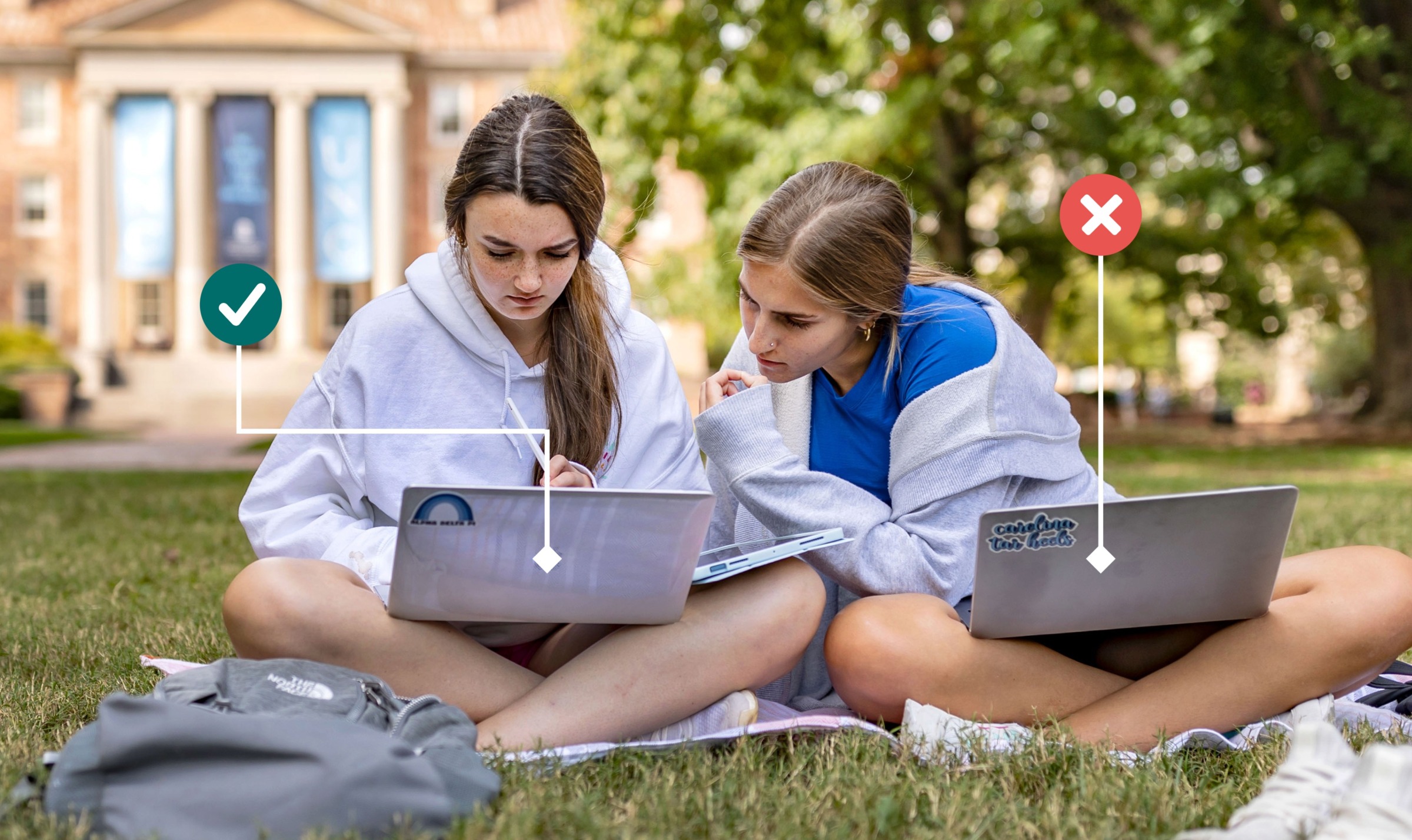
Imagine two first-year students in a packed introductory biology course. Both dream of becoming physicians. One regularly logs on to the course site to review lecture notes, take practice quizzes, watch videos, and check the syllabus; the other opens the course site only as deadlines approach.
Just two weeks into the semester and weeks before the first exam, their differing approaches to learning are already beginning to tell a story for researchers in the UNC School of Education.
For Matthew L. Bernacki, Ph.D., an associate professor at the School and director of the Center for Learning Analytics, those students’ early actions provide opportunities to identify who may be struggling and then provide support before they fall behind.
At the center of this work is CLICKSTREAM, a learning analytics platform Bernacki and his collaborators developed to combine students’ online learning data with instructional expertise and research grounded in the science of learning.
Using artificial intelligence, CLICKSTREAM detects student learning patterns within the first few weeks of a course. Bernacki and his collaborators have predicted with up to 80% accuracy which students are likely to earn a C or lower, identifying timely opportunities for educators to intervene.
And those interventions can improve performance by as much as a full letter grade. For some students, that difference can help keep a degree — and a future career in medicine or another STEM field — within reach.
But the power of CLICKSTREAM does not come from artificial intelligence alone.
“The foundation of any decent artificial intelligence is human intelligence,” Bernacki said. “We have experts on design, on pedagogical moves in teaching, and on learning processes. These can be used to enrich the story the data tell and humanize the way that we use AI in education, particularly in CLICKSTREAM.”
CLICKSTREAM uses technology to translate educators’ knowledge about teaching and learning into earlier, more meaningful support for students.
How does CLICKSTREAM work?
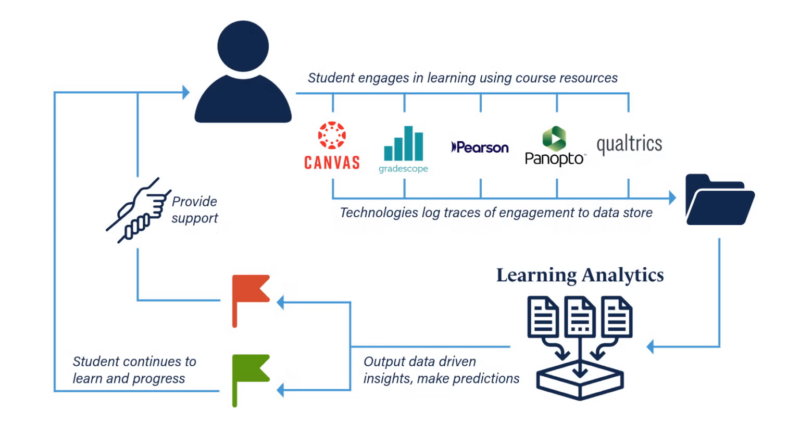
1. Capturing the digital footprints of learning
Every time a student interacts with a learning management system, such as Canvas on Carolina’s campus, they leave behind digital traces.
Students open course materials, watch videos, attempt quizzes, download study guides, and submit assignments, generating data about when and how they use learning opportunities.
In traditional institutional analytics, these interactions often become little more than rows of data in a database. For CLICKSTREAM, this is only the beginning.
2. Adding meaning to the data
A click alone reveals little to researchers. Opening a practice quiz a week before an exam means something different from opening it the night before. Reviewing notes, submitting an assignment, and participating in an online discussion also provide additional considerations.
This is where CLICKSTREAM begins to differ from many learning analytics systems by “enriching” raw data with information about course design, instructional resources, deadlines, grading stakes, and intended learning activities with faculty, instructional designers, and learners to better understand how courses are structured and how students should engage.”Establishing course designs, centering on objectives, building out assets, looking at the timing of when students should be using those different kinds of assets — we bring all that into the equation,” he said.
According to Bernacki, this approach — focusing students’ early actions paired with course-specific instructional resources, rather than paired with students’ demographic characteristics — differs from industry competitors’ learning analytics tools.
“Models that rely on demographics only tell a learner their odds of success based on who they are,” Bernacki said. “Ours focus on what they do.”
3. Applying the science of learning
Once the data has been enriched, researchers look for patterns grounded in learning theory, examining behaviors associated with self-regulated learning, including how students plan, set goals, choose strategies, persist through challenges, monitor their progress, and adjust over time.CLICKSTREAM reveals how those behaviors unfold across a semester, including patterns of procrastination, delayed engagement, consistent effort, and sustained participation.
The goal is not simply to measure whether students are active, but to understand how they learn: whether they begin assignments early, spread studying over time, return to useful resources, and adjust strategies when needed.
“Our learning analytics are done through the lens of learning sciences, not institutional analytics, meaning the focus is not simply on measuring activity, but on understanding learning,” Bernacki said.
4. Predicting student success
Using machine-learning models informed by learning theories, CLICKSTREAM can identify students who may be at risk before the first exam.
“We can tell within a couple of class periods whether or not that student is likely to succeed or fail to achieve their learning goals,” Bernacki said.
After two class meetings, CLICKSTREAM predicted with more than 75% accuracy whether UNC-Chapel Hill introductory biology students would earn the grade needed to continue in STEM; other studies reached roughly 80% accuracy in identifying students likely to earn a C or below.
But for Bernacki, prediction is only valuable if it leads to action. Identifying risk early gives educators time to reach students when support can still change the trajectory.
5. Turning data insights into support
Once CLICKSTREAM identifies students who may be struggling, the next challenge is helping them develop more effective approaches to learning.
The platform provides educators with opportunities to deliver practical resources and guidance. That could be a nudge to attend course review sessions, a referral to a tutor or learning coach, or an offer of the digital learning support Bernacki’s team has developed called the Science of Learning to Learn.
The Science of Learning to Learn, a digital skill training intervention, provides resources that help students plan, study, and monitor their learning.”The skills provided by the Science of Learning to Learn are the keys to actually succeeding in these kinds of courses,” he said.
According to Center for Learning Analytics findings, students who utilized these supports improved their exam and course performance by as much as a letter grade, with especially strong benefits for first-generation college students.
Looking ahead and opportunities to scale
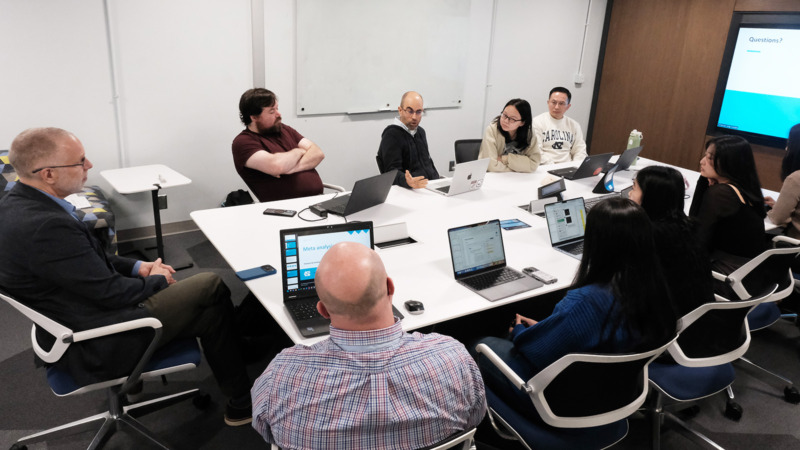
Today, CLICKSTREAM includes learning data from partnerships at UNC-Chapel Hill and beyond. Researchers, including recent doctoral graduate Robert Plumley (’26 Ph.D.) and emerging learning analysts in the School’s Master of Arts in Educational Innovation, Technology, and Entrepreneurship program, have tagged dozens of introductory STEM courses with information about instructional design and learning processes.
The next frontier is using rapidly improving artificial intelligence to make this work possible across more courses and learning environments.
“Let’s build an AI model that draws upon the expertise of the teaching and learning community,” Bernacki said.
Such a model could “learn how to think like a teacher” by interpreting syllabi, instructional materials, and course design. AI could handle labor-intensive tagging and analysis while educators provide the context, judgment, and oversight needed to use the insights responsibly.
The goal is not to replace teachers, but to extend their expertise so more instructors can recognize patterns and provide timely support.
After more than a decade of research, development, and partnership-building, Bernacki and the Center for Learning Analytics are entering a new phase. The team is looking beyond higher education, exploring how the same approach can support K-12 learners through partnerships with North Carolina school districts.
That expansion could bring new insight into how students learn years before they reach a college biology lecture. And with an earlier understanding of where they struggle and what helps them succeed, more students may have the opportunity to reach the college classroom — and whatever comes after it.