Education
- Graduate Certificate, 2025 – University of Pennsylvania, Data Science for Digital Learning Platforms
- Ph.D. 2020 – Michigan State University, dual degree in Curriculum, Instruction and Teacher Education (CITE) & Measurement and Quantitative Methods (MQM)
- Graduate Certificate, 2015 – Michigan State University, Science Education
- MS, 2013 – Bowling Green State University, Chemistry
- BS, 2019 – Bowling Green State University, Chemistry
Areas of Expertise
- AI in Education
- STEM Education
- Learning Sciences
- Educational Technology
- Data Science
- Learning Analytics
- Measurement
Background
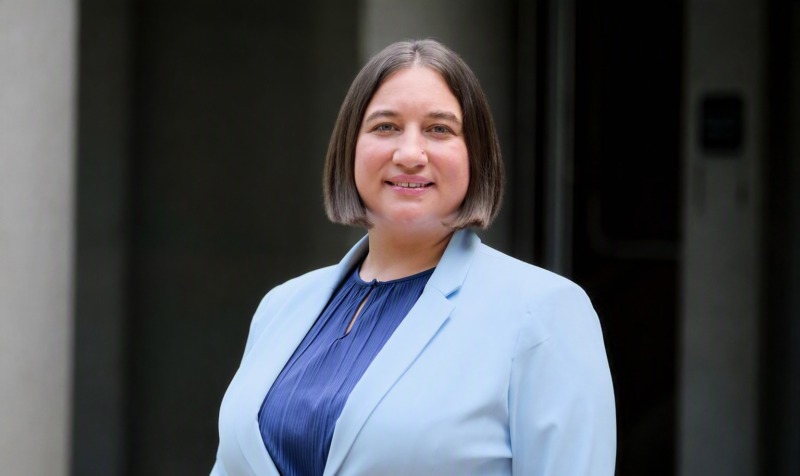
Leonora Kaldaras, Ph.D., is an Assistant Professor of Artificial Intelligence in K–12 Education at the UNC School of Education. Her research pioneered the development of theory-guided artificial intelligence for education — an approach that embeds validated learning theories directly into AI systems to guide instructional decisions, personalize learning, and generate interpretable evidence about how students learn. Rather than relying solely on data-driven approaches, her work integrates artificial intelligence with the learning sciences to develop AI systems that are transparent, explainable, and grounded in established theories of learning.
Trained as a chemist before transitioning into science education and the learning sciences, Dr. Kaldaras became interested in understanding how students develop the ability to apply knowledge to solve complex problems. As a Visiting Scholar at the Stanford Graduate School of Education and PhET Interactive Simulations at the University of Colorado Boulder, she worked with Nobel Laureate Dr. Carl Wieman and Dr. Kathy Perkins to design self-guided learning experiences that foster mathematical and scientific sensemaking through interactive simulations. She continues this line of research as a recipient of the Spencer Postdoctoral Fellowship, where she is advancing a new generation of theory-guided AI learning environments grounded in validated learning progressions. She is also a National Science Foundation SIARM for STEM Fellow, participating in the Summer Institute in Advanced Research Methods for STEM Education Research (SIARM II), a three-year fellowship that prepares early- and mid-career scholars in advanced quantitative methods, equity, and leadership in STEM education.
Although her current work focuses primarily on mathematics and science education, Dr. Kaldaras views these disciplines as a foundation for developing general principles of theory-guided AI that can be applied across educational settings. She currently serves as Co-Principal Investigator on a National Science Foundation–funded project developing AI systems that provide learning progression-guided formative feedback on students’ scientific reasoning. By bringing together artificial intelligence, learning sciences, educational measurement, and STEM education, her research seeks to establish a new paradigm for educational AI—one in which learning theory serves as the foundation for how AI interprets learner thinking, adapts instruction, and supports both learners and educators.
Research
Dr. Leonora (Lora) Kaldaras’ research examines how artificial intelligence can be designed to better understand, support, and accelerate learning. Her work integrates learning sciences, educational measurement, and AI to develop educational systems that adapt to students’ developing understanding rather than simply evaluating whether answers are correct or incorrect. She is particularly interested in how AI can provide personalized instructional support while generating new evidence about how learning develops over time.
Her current research focuses on mathematics and science education, where she develops AI-supported learning environments and formative assessment systems grounded in validated learning progressions. Using classroom studies, learning analytics, and human-AI collaboration, she investigates how AI can support students in developing complex reasoning, mathematical thinking, and knowledge application while providing teachers with interpretable evidence to guide instruction. Her broader goal is to establish principled approaches for designing AI systems that enhance both educational practice and learning research.
Funded Projects
National Academy of Education (NAEd)/Spencer Postdoctoral Fellowship (2025). AI-Assisted Learning of Blended Math–Science Sensemaking (AI4MSS). Lead Principal Investigator. Spencer Foundation, $70,000. (September 1, 2025 – August 31, 2026).
National Science Foundation (NSF Award #2200757) (2022). Evaluating Effects of Automatic Feedback Aligned to a Learning Progression to Promote Knowledge-in-Use. Co-Principal Investigator. $2,046,509. (September 1, 2022 – August 31, 2027).
Publications
Kaldaras, L., & Wieman, C. (2026). Simulation supported directed self-guided learning of blended math-science sensemaking for historically marginalized STEM learners. Computers & Education, 105639.
Kaldaras, L., & Wieman, C. (2025). Investigating blended math-science sensemaking with historically marginalized STEM learners. International Journal of STEM Education, 12(1), 44.
Kaldaras, L., Akaeze, H. O., & Reckase, M. D. (2024, August). Developing valid assessments in the era of generative artificial intelligence. In Frontiers in education (Vol. 9, p. 1399377). Frontiers Media SA.
Kaldaras, L., Haudek, K., & Krajcik, J. (2024). Employing automatic analysis tools aligned to learning progressions to assess knowledge application and support learning in STEM. International Journal of STEM Education, 11(1), 57.
Kaldaras, L., Wang, K. D., Nardo, J. E., Price, A., Perkins, K., Wieman, C., & Salehi, S. (2024). Employing technology-enhanced feedback and scaffolding to support the development of deep science understanding using computer simulations. International Journal of STEM Education, 11(1), 30.
Kaldaras, L., Akaeze, H., & Krajcik, J. (2021). Developing and validating Next Generation Science Standards‐aligned learning progression to track three‐dimensional learning of electrical interactions in high school physical science. Journal of Research in Science Teaching, 58(4), 589-618.