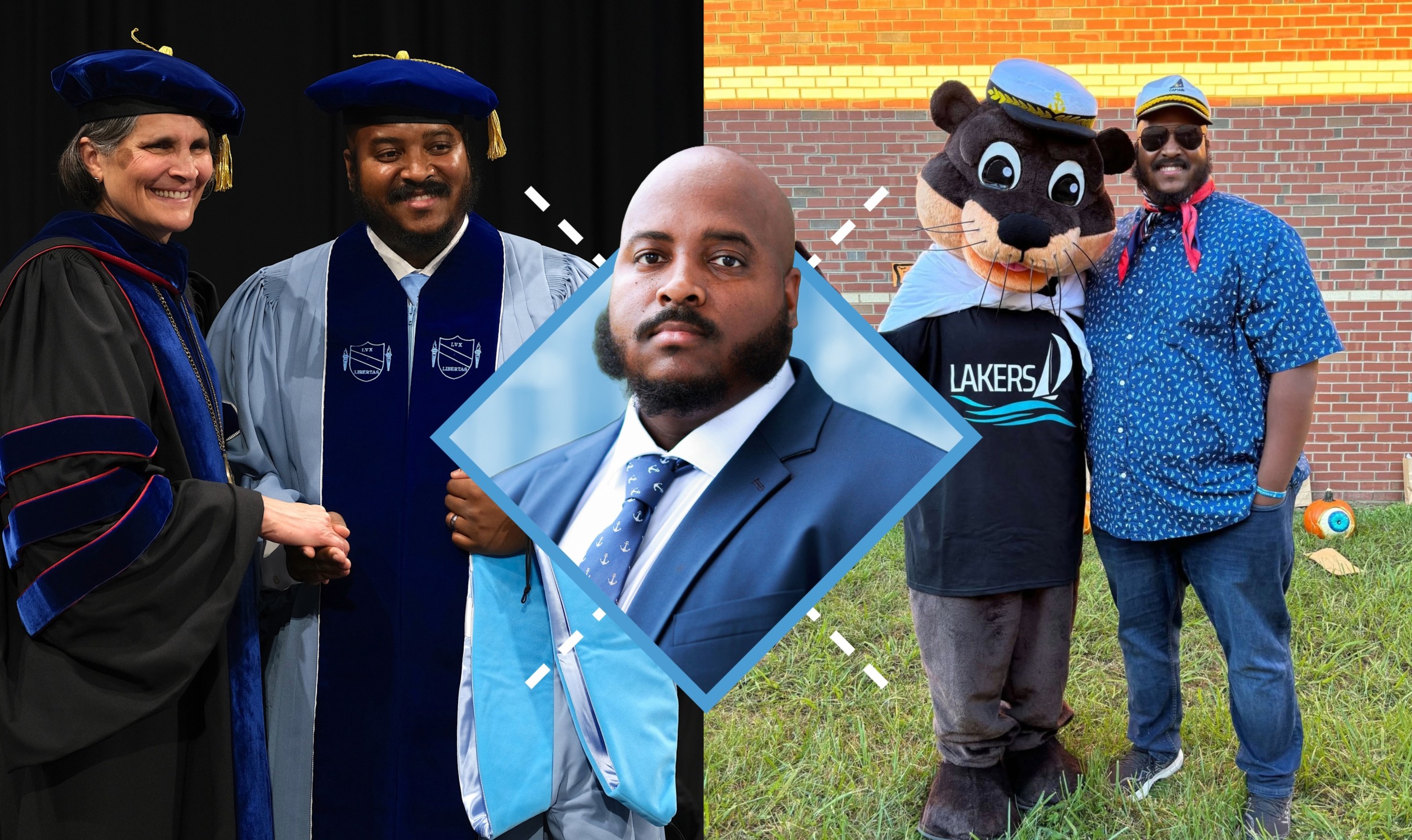
As a former teacher turned elementary school principal, Dwayne Johnson (’20 M.S.A., ’26 Ed.D.) has experienced success in education from two very different perspectives.
“When you’re a teacher, you feel wins every day,” Johnson said. “But as a principal, it’s almost like you’re swinging for the fences. There’s some big risk involved.”
Those bigger wins — improving schoolwide outcomes, supporting teachers, and helping more students succeed — often come with more complex challenges. In recent years, one of those challenges has been attendance.
Like many education and school leaders navigating the years after the COVID-19 pandemic, Johnson said he wrestled with tough questions about chronic absenteeism. Chronic absenteeism is defined as missing more than 18 days — or 10% — of a 180-day school year. Johnson said students were missing school for a variety of reasons, attendance expectations had shifted, and there wasn’t much guidance on how schools should respond.
“There weren’t a lot of answers,” Johnson said.
Those questions became the foundation of his dissertation in practice within the UNC School of Education’s K-12 Leadership concentration of the Ed.D. in Educational Leadership program: “A Mixed Methods Case Study of School Leaders’ Understanding of and Response to Chronic Absenteeism in a Rural School District.” The study examined how leaders understand and respond to chronic absenteeism in rural communities, where barriers such as transportation, staffing, and limited resources can affect student attendance.
Johnson didn’t initially intend to study attendance, but his dissertation topic needed to connect directly to his work as a principal, serving both his school and his profession.
“I have to do something that I’m passionate about,” he said. “I have to find something that’s making me feel like I’m helping people.”
The turning point came during a district attendance committee meeting, when he recognized that of the students who were considered chronically absent, only a portion entered the truancy process. The disconnect revealed a gap in how educators understood attendance and sparked a new line of inquiry for him — which helped position him as a leader beyond his school.
Johnson’s dissertation chair, faculty member Chris Scott, Ed.D., described the project as “deeply grounded in a genuine, high-stakes problem of practice” affecting rural districts and historically marginalized students. Rather than viewing absenteeism as a compliance issue, he noted that Johnson framed it as “a daily barometer of school relevance, belonging, and equity.”
That perspective was deeply personal to Johnson.
“I’ve always had a passion for looking at the rural lens because that’s where I’m working. That’s where I grew up,” he said. “I feel those spaces are usually underserved in research.”
Better data leads to better decisions
Using rural student-level attendance data, Johnson examined patterns among chronically absent students by grade level, race, gender, and absence type before pairing those findings with focus group interviews of school attendance teams and analysis of district attendance policies.
Johnson’s analysis revealed that absenteeism looks very different across student groups.
Among chronically absent students, Black and Hispanic students were more likely to accumulate unexcused absences, while White students were more likely to have absences classified as illness-related or otherwise excused. Kindergarten students had the district’s highest rates of chronic absenteeism, and suspension-related absences were concentrated among Black and Hispanic male kindergartners.
Those patterns raised important questions about access, resources, and support systems.
Johnson said, generally, school leaders are not doing this kind of work daily, where they’re looking at absenteeism by subgroups. “We do that all the time with academics, but we never do that with attendance.”
He found that school leaders often approached absenteeism through one of two lenses: “ecological empathy,” which recognizes the barriers families face, or a personal responsibility lens, which places primary responsibility for attendance on families.
Staffing capacity often shaped which perspective leaders adopted. Schools with greater personnel resources were more likely to engage families through home visits, community partnerships, and individualized support, while schools operating under significant staffing constraints often struggled to move beyond compliance-focused responses.
His research also highlighted challenges unique to rural communities, with transportation emerging as one of the most consistent barriers. “If you miss the bus, you’re 30 minutes away from the school with no public transportation,” Johnson said.
For many rural families, Johnson also noted transportation affects far more than the trip to school. Limited access to healthcare providers, longer travel distances, and fewer community resources can also contribute to students missing instructional time.
Getting kids back in school
The research became most meaningful when it moved from the dissertation into Johnson’s day-to-day work as principal of Woodland Elementary in Person County.
There, he and his staff increased communication with families, conducted home visits, highlighted attendance data throughout the year, and broadened attendance recognition efforts beyond perfect-attendance awards.
Over time, he noticed a shift.
Johnson said: “The culture changed because it became a culture where parents were calling me, ‘Mr. Johnson, he’s going to miss. I’m letting you know. I think that’s under 10%, right? Can you check for me?’ They could speak to what it meant to be chronically absent and why it was a problem.”
Chronic absenteeism at Woodland Elementary dropped from 15.8% in 2023-24 to 12.2% in 2024-25, with early projections suggesting another significant decline in 2025-26.
“We all got on the same page about attendance,” Johnson said. “And I think that was the number one thing that made our [academic performance] data the highest it’s been in 10 years. It’s because we got kids back in school.”
The doctoral experience also changed the way Johnson sees his role as a school leader.
“Unlike before, I now want to run toward complexity and try to figure out these problems,” he said. “The doctorate allowed me to do that.”
Scott said he sees that mindset as one of the dissertation’s most significant outcomes and plans to incorporate Johnson’s study into future educational leadership courses at Carolina.
For Johnson, the research wasn’t only about attendance rates. It was about building school systems that recognize barriers and ensure every student has the support they need to keep showing up.
“You may not use everything I teach you,” Johnson said, telling his students. “But I’m going to tell you what you’re going to use every single day: your willingness to be present, even when you don’t want to, is going to help you navigate life.”