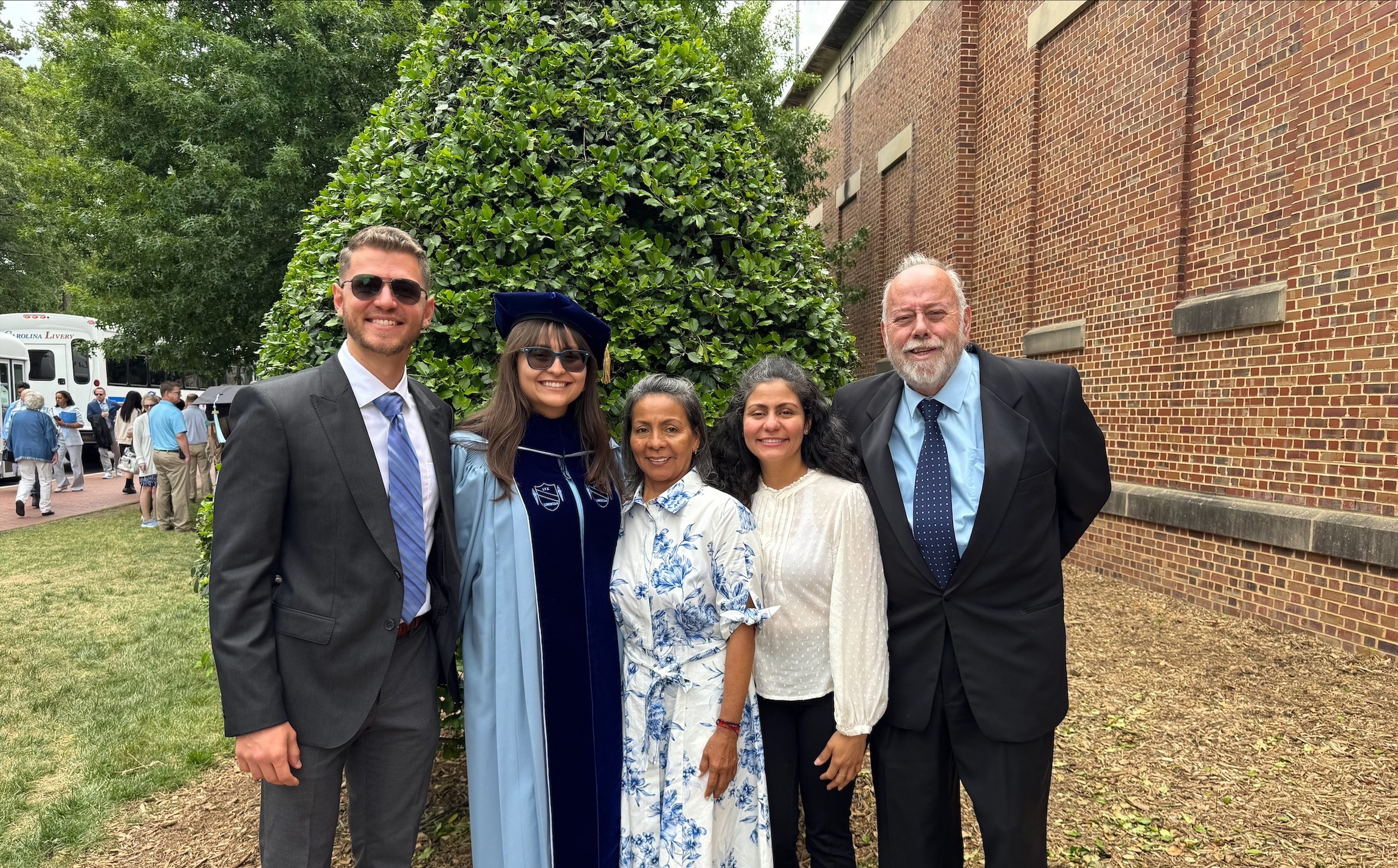
For Luz E. Robinson (’25 Ph.D.), a graduate of the UNC School of Education’s Ph.D. in School Psychology program, understanding school safety means looking beyond physical protection to the experiences and relationships that shape students’ well-being and learning.
“When I think about safety, I do not mean only physical safety,” Robinson said. “Psychological safety is a major component.”
That perspective has shaped Robinson’s research, which examines how schools can better respond to the needs of children and adolescents.
“School psychology was the best fit for me,” Robinson said. “Schools reach children and families who might not otherwise have access to community centers, hospitals, insurance, or other services. School-family-community partnerships are critical to child and family well-being.”
Examining school safety through research
As an undergraduate at the University of Florida, Robinson worked at a child advocacy center, where her experiences with children affected by trauma prompted questions about how research could inform policies and practices to better protect them.
During that time, she met Dorothy Espelage, Ph.D., now the William C. Friday Distinguished Professor of Education, whose research on bullying and violence prevention aligned with Robinson’s developing interests.
When Espelage joined the School’s faculty in 2019, Robinson followed as a research lab coordinator before beginning her doctoral studies in 2020. Working alongside Espelage in the Research Addressing Violence in Education (RAVE) Lab, she contributed to studies examining school safety and the factors influencing students’ experiences.
In a 2024 study published in the Journal of Latinx Psychology, Robinson, Espelage, and collaborators examined interpersonal violence among 1,087 adolescent Latinas attending Colorado high schools. Their findings identified associations between sources of support, including family relationships and access to services, and lower rates of certain forms of violence victimization.
Another study published in Behavioral Sciences in 2025 examined responses from 538 school psychologists nationwide. Researchers identified concerns about student aggression, mental and behavioral health needs, and staffing shortages, along with opportunities to strengthen school safety through professional development and relationships within schools.
“Schools fit well with the social-ecological framework I use in my work,” Robinson said. “We can think about individual and interpersonal interventions, and then broaden our attention to relationships among schools, families, and communities. We also must consider the policies at local, state, and federal levels that can support schools. Prevention science can address all of those levels, and schools are places where those connections come together.”
Connecting research with practice
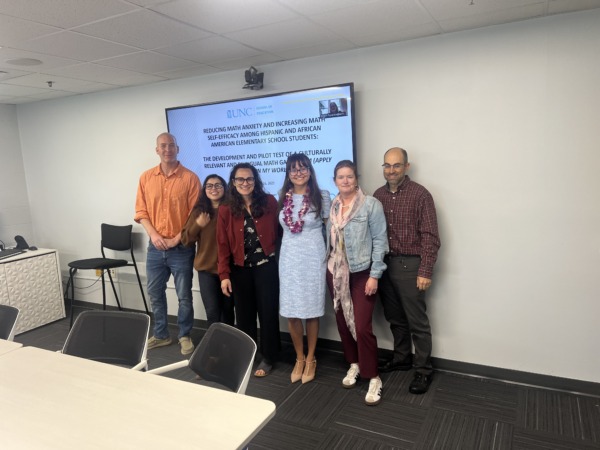
Robinson’s interest in student safety also informed her doctoral dissertation, which explored the psychological dimensions of learning, particularly how anxiety can influence students’ confidence in mathematics.
For her dissertation, she developed a bilingual mathematics computer game designed to help students manage math anxiety and build confidence in their abilities. Working with students and researchers, she incorporated familiar activities, strategies for managing frustration, and opportunities to practice mathematical concepts in English or Spanish.
During her dissertation research, a mother called Robinson to share something she had never been able to do before: help her child with math homework. The game’s bilingual features gave the parent an opportunity to work through mathematical concepts with her child in her preferred language.
“I started to think about how important social and emotional skills are for youth and whether adults, specifically teachers, had the tools and support in graduate school to grow those skills themselves before entering the profession,” Robinson said.
As a graduate student at Carolina, Robinson contributed to the School’s Diverse and Resilient Educators Advised through Mentorship (DREAM), a teacher residency program made possible by a $4.8 million U.S. Department of Education grant that ended in 2025.
Through the program, she led monthly workshops for graduate students supported by the grant, providing training in transformative social-emotional learning through activities designed to promote well-being and safety among educators and students.
“The interdisciplinary collaborations enabled me to work with teacher educators on something that connected research with their work preparing future teachers,” Robinson said.
To further prepare for working with students and families, Robinson pursued clinical experiences at El Futuro, the Carolina Institute for Developmental Disabilities, and Durham Public Schools. She also completed an American Psychological Association-accredited predoctoral internship at the Medical University of South Carolina (MUSC), gaining experience supporting children and families in medical and outpatient mental health settings.
“This work brought me back to issues I first encountered as an undergraduate at the child advocacy center, but with more training and responsibility,” Robinson said. “Because I spoke Spanish, I was also able to help families connect with resources for basic needs, legal services, and other support. I valued the clinical training and relationships I developed at MUSC, which provided a foundation I build on in my role as a faculty researcher.”
Extending the research beyond Carolina
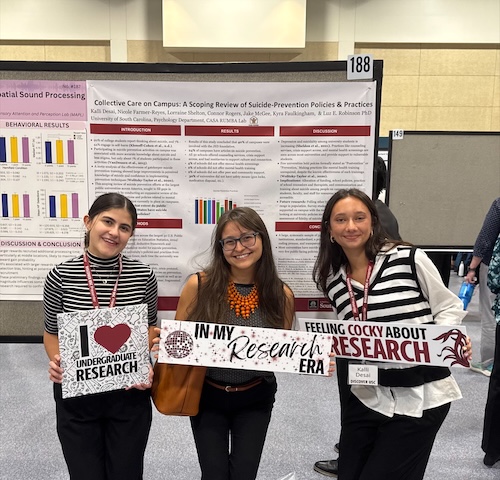
Now an assistant professor in the Department of Psychology’s School Psychology program at the University of South Carolina, Robinson builds on her Carolina experiences through CASA RUMBA (Child and Adolescent Safety Advocacy Research on Uplifting Mental Health, Belonging, and Access). The multilingual, community-engaged research lab examines factors influencing student mental health and school safety, with an emphasis on developing approaches to prevention.
CASA RUMBA’s current work also includes the CAMPUS study, which examines undergraduate students’ mental health and safety on college campuses. Researchers are collecting quantitative and qualitative data to inform recommendations for higher education institutions seeking to strengthen student mental health and safety. Additional projects within the lab focus on suicide prevention and community outreach.
Robinson serves alongside Espelage as a co-principal investigator on a $3.9 million project funded by the Institute of Education Sciences, Disability Anti-bullying Training for Elementary Special and General Education Teachers (Project DIAL). The longitudinal, cohort-based, cluster-randomized controlled trial examines the impact of DIAL professional development for general and special education teachers on students’ social skills and bullying behavior. Researchers are also evaluating its effects on teacher self-efficacy, classroom management, and bullying prevention practices.
“This research is fulfilling for so many reasons, but especially because the trial is taking place in the school district I attended as a student,” Robinson said. “As one of the most diverse school districts in the U.S., it has been an enriching experience to be back in the schools for data collection with my colleagues and the graduate and undergraduate research assistants in my lab.”
As Robinson continues her research, her work reflects the connections between her academic training, clinical experiences, and ongoing efforts to understand how schools can better support the students and educators they serve.
“My wins are and have always been collective wins,” Robinson said. “Every day I wake up in gratitude because, as an assistant professor, I get to pour into student growth and success, as was done for me.”