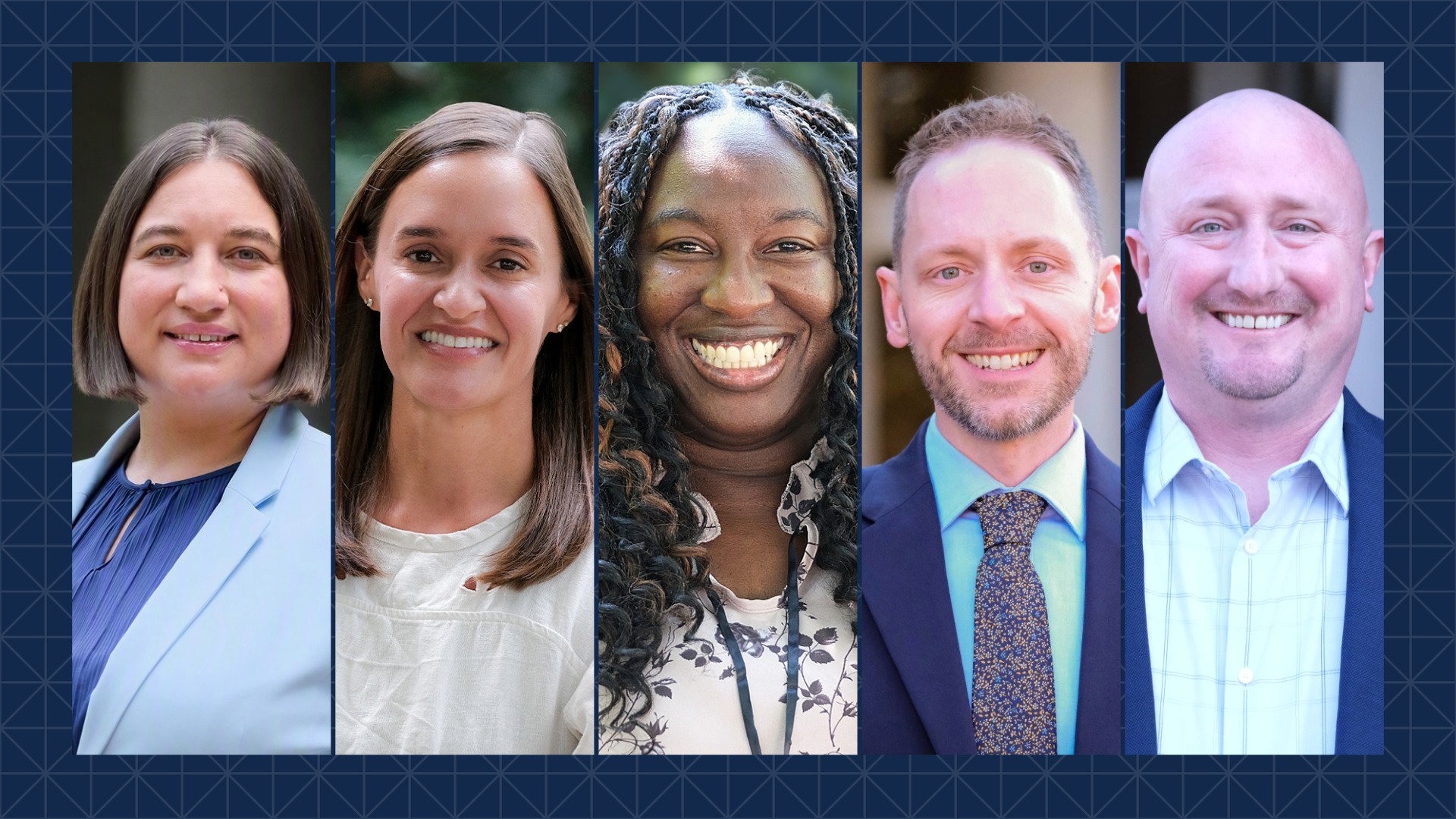
The UNC School of Education welcomes five new faculty members: Leonora Kaldaras, Emily Kitching, Adjoa Mensah, Dustin Evatt, and Brad Smith.
Kaldaras, Kitching, and Mensah join the School for the 2026-27 academic year, while Evatt and Smith began their faculty appointments during the spring 2026 semester. Collectively, they bring experience and research foci that span K-12 classrooms, school counseling, teacher preparation, instructional design, artificial intelligence, higher education administration, organizational leadership, and continuous improvement — adding expertise that builds upon and strengthens the School’s ongoing work.
“We are excited to welcome these outstanding faculty members to Carolina and the School of Education community,” said Jill V. Hamm, dean of the School and William C. Friday Distinguished Professor of Education. “Their expertise enhances and extends the work of a faculty who are already making meaningful impact across North Carolina and beyond. Looking ahead, I can’t wait to see how these new faculty members will contribute to the School’s research, programs, and partnerships.”
Learn more about their background and expertise.
Leonora Kaldaras, Ph.D.
Leonora “Lora” Kaldaras joins the School as an assistant professor of artificial intelligence in K–12 education.
Kaldaras’ research brings together artificial intelligence, learning sciences, educational measurement, data science, and STEM education to develop systems that better understand and support how students learn. Her work focuses on theory-guided AI, an approach that embeds established learning theories into educational technologies to create more transparent, explainable, and personalized learning experiences.
A key area of her scholarship examines learning progressions, which describe how students’ understanding develops from introductory ideas toward more sophisticated knowledge. Through AI-supported learning environments, formative assessment, and learning analytics, Kaldaras studies how technology can strengthen students’ scientific reasoning and mathematical thinking while providing educators with meaningful evidence to guide instruction.
Before joining Carolina, Kaldaras held faculty and research appointments at the University of Houston, Texas Tech University, Stanford University, and the University of Colorado Boulder. She currently serves as co-principal investigator on a National Science Foundation-funded project developing AI systems that provide learning progression-guided feedback on students’ scientific reasoning.
Kaldaras earned her Ph.D. from Michigan State University in curriculum, instruction and teacher education and measurement and quantitative methods. She also holds graduate certificates in data science for digital learning platforms and science education, as well as a master’s degree and bachelor’s degree in chemistry from Bowling Green State University.
Emily Kitching, Ph.D., NCC, ACS, NCSC
Emily Kitching joins the School as an assistant professor in the Master of Education in School Counseling program.
Kitching brings seven years of experience as an elementary school counselor, during which time she worked closely with students, families, educators, and school communities. That experience shaped her understanding of the many roles school counselors hold, from directly supporting young people to collaborating with adults and strengthening the broader conditions in which students learn and develop.
Her time in schools continues to ground her work as a teacher and scholar. Kitching is committed to preparing future school counselors who are reflective, collaborative, and equipped to respond to the evolving academic, career, social, and emotional needs of their students.
Kitching’s research examines how individual experiences and organizational conditions interact to shape school counselors’ professional lives and their capacity to support young people. Her scholarship focuses on school counselor well-being, professional identity and career development, workplace supports, and the conditions that contribute to sustainable and effective professional practice.
She also studies protective and promotive factors within schools that support youth well-being. Through this work, Kitching aims to produce actionable evidence that can inform policy, professional practice, and organizational decision-making while strengthening outcomes for both school counselors and the students they serve.
Kitching earned her Ph.D. in counselor education and supervision from Virginia Commonwealth University in 2026. She also earned a master’s degree in school counseling and a post-master’s certificate in educational leadership from VCU, as well as a bachelor’s degree in commerce from the University of Virginia.
She is a licensed school counselor in Virginia and holds credentials as a National Certified Counselor, Approved Clinical Supervisor, and National Certified School Counselor.
Adjoa Mensah, Ph.D.
Adjoa Mensah joins the School as a clinical assistant professor and program director of the Bachelor of Arts in Education in Elementary Education program.
Mensah began her career as an elementary educator in Canada, teaching for 15 years in French immersion and dual-language programs across grades K-8. Working with students in multilingual classrooms sparked her interest in how thoughtful instructional design and educational technology can broaden learning opportunities and provide meaningful support for students and teachers.
Her classroom experience led her into teacher education, where she has worked to connect the everyday needs of educators with research, technology, and curriculum design. Mensah also holds an endorsement in mathematics instruction, adding to her experience preparing teachers across elementary content areas.
Before joining Carolina, Mensah served as a teacher educator and instructional designer at the University of Nevada, Las Vegas. In those roles, she taught elementary teacher preparation courses, designed online learning experiences, and worked alongside faculty members to create student-facing resources and tools.
Since 2024, she has served as an instructional designer for UNLV’s fully online Bachelor of Science in Cybersecurity program. She also contributed to grant-funded projects involving STEM education, computer science, educational technology, and teacher professional learning.
Mensah previously led UNLV’s Paraprofessional Pathway Program, which supports paraprofessionals as they transition into teacher licensure programs. Through that work, she helped expand pathways into teaching while responding to local educator shortages.
Her research examines how emerging technologies, particularly artificial intelligence, can support teaching, learning, and instructional design. She studies how elementary and middle grades educators plan instruction with AI, develop the knowledge and confidence to integrate technology effectively, and create student-centered learning experiences.
Using quantitative and qualitative methods, Mensah also examines the quality of technology integration, with particular interests in science education, curriculum design, online and hybrid learning, and AI-enhanced instruction. Her work seeks to translate research into practical strategies educators can use to make thoughtful, evidence-based decisions about technology.
Mensah earned her Ph.D. in teacher education with a focus on technology integration from the University of Nevada, Las Vegas. She also holds a master’s degree in elementary education from Daemen University, a master’s degree in French studies from the University of Kent, and a bachelor’s degree in psychology from the University of Western Ontario.
Dustin Evatt, Ed.D.
Dustin Evatt joined the School during the spring 2026 semester as a clinical associate professor. He also serves as program director of the online Ed.D. in Educational Leadership with a concentration in Organizational Learning and Leadership. Evatt also teaches in the undergraduate Human and Organizational Leadership Development program.
Evatt joined Carolina from North Carolina State University, where he directed the Leadership: Cross-Disciplinary Perspectives Minor within the Shelton Leadership Center. In that role, he oversaw curriculum design, program assessment, and research focused on values-based leadership.
His work at NC State brought together students from different academic areas to study leadership through multiple disciplinary perspectives. That experience informs his approach to helping learners understand leadership not simply as an individual position or set of traits, but as a practice shaped by relationships, systems, organizational expectations, and the environments in which people work.
Evatt’s scholarship examines the organizational norms and structures that influence leadership practice and efforts to improve organizations. His research considers how people interpret and navigate organizational systems, as well as how leaders can respond thoughtfully to the needs of individuals, teams, and communities.
His professional background also includes work in higher education and student affairs, providing him with experience with student development, leadership education, program administration, and organizational learning. At Carolina, that combination of practice and scholarship informs his teaching of working professionals in the online doctoral program and undergraduate students preparing to lead across sectors.
Evatt earned his Ed.D. in educational leadership from Appalachian State University. His dissertation received the Southern Association for College Student Affairs’ 2020 Dissertation of the Year Award.
He also holds a master’s degree in higher education and student affairs from the University of Vermont and a bachelor’s degree in integrated marketing communication from Winthrop University.
Brad Smith, Ed.D.
Brad Smith joined the School during the spring 2026 semester as a clinical assistant professor in the online Ed.D. program and the undergraduate Human and Organizational Leadership Development program. He also serves as Capstone Director for the Ed.D. concentration in Organizational Learning and Leadership and as president of the North Carolina Association of Colleges for Teacher Education.
Smith came to Carolina from the University of North Carolina at Charlotte, where he served as director of assessment and accreditation in the Cato College of Education. In that role, he supported processes that help academic programs evaluate their effectiveness, meet professional standards, use evidence to guide decision-making, and sustain continuous improvement.
Smith’s research examines how organizational leadership and change management can improve organizational performance and the experiences of individuals within those organizations. His work considers not only whether organizations accomplish their goals, but also how their systems, leadership practices, and improvement efforts affect the people responsible for carrying out their missions.
His background in assessment and accreditation provides an applied foundation for this scholarship. Through his work, Smith has experience helping organizations collect and interpret evidence, evaluate program outcomes, respond to external standards, and use findings to strengthen policies and practices.
Smith earned his Ed.D. in educational leadership and higher education from UNC Charlotte. He is also a graduate of Carolina, where he earned a Master of Arts in Teaching in secondary social studies from the School and a bachelor’s degree in history.