
In the U.S. today, there are many different versions of family life. There are many different family structures.
Families form through marriage, cohabitation, and committed partnerships. Stepfamilies form in similar ways and involve new couple relationships in which one or both partners have a child or children from prior relationships.
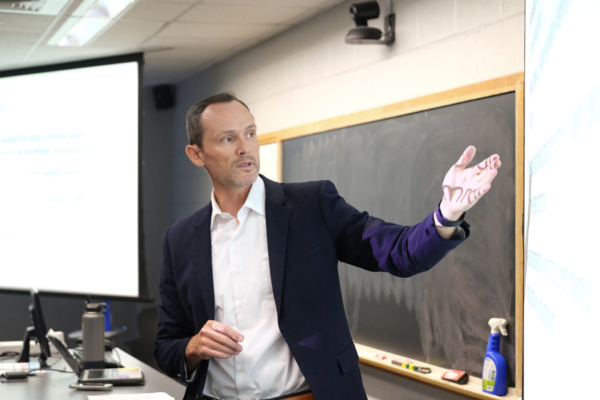
Rather than asking which family structure is best for children, Todd Jensen, Ph.D., the Gary Stuck Faculty Scholar in Education and an assistant professor at the UNC School of Education, conducts research that centers a different question: What helps children thrive within the families they have?â¯
Specifically, Jensen and his Thriving Through Family Transitions (THRIFT) Research Lab studies what helps young people and their stepfamilies successfully navigate those familial transitions.
According to the Pew Research Center, 17% of minor-aged children (and 22% of teens) in the U.S. currently live with a stepparent.
“You can watch almost any TV show, you can look at reality shows, you can look at celebrities and other public figures, and you’ll see people talking about the fact that they have children from prior relationships that they’re bringing into new relationships,” Jensen said. “When you start looking for it, stepfamilies are incredibly prevalent.”â¯
Within stepfamilies, children may move between households, build relationships with stepsiblings or half-siblings, and adjust to changing roles and routines.â¯There are challenges, but also promising opportunities.
Jensen — whose work draws from developmental science, family science, and clinical social work — and graduate and undergraduate students in the THRIFT Research Lab focus on the conditions that promote positive outcomes during family changes. Their findings are helping to strengthen youth development and well-being, families in transition, and systems that serve young people.
“The real heartbeat of the lab is to understand what works well when family structures change, what actually works to help families function well — to not just survive but thrive amid these changes,” Jensen said.â¯
Finding what works within families
Jensen’s interest in better understanding family transitions began well before his career as a researcher. Experiencing changes within his own family while growing up generated questions about how adults could best serve young people at critical points in their lives.
Across degrees in family science and clinical social work, followed by a Ph.D. in social work, one idea has remained central for Jensen: All young people deserve opportunities for healthy development and well-being.
For Jensen, youth well-being can and does exist within all kinds of families, including the many stepfamilies that surround us. His scholarship challenges the tendency to view one type of family as the benchmark against which all families should be measured.
A recent THRIFT Research Lab study, using national data from more than 18,000 caregivers of adolescents, examined outcomes across seven family structures — including measures of adolescent flourishing, general health, and behavioral health concerns. Findings suggest adolescents are often more alike than different across family structures and that factors within their lives — such as communication with caregivers, caregiver involvement, and safety at school and in neighborhoods — can be more consequential for well-being than family structure itself.
“Children can fare well across a number of different outcomes in a wide variety of family structures,” Jensen said. “The question then becomes for me: What leads to positive outcomes for children residing in specific types of families, such as stepfamilies?”
Within that broader question, Jensen seeks to understand how young people answer questions such as:
- What does it mean to have a stepparent?
- Who are they to me?
- How should they function in my life?
- How should I function in theirs?
The THRIFT Research Lab researches these questions through an idea Jensen describes as “ambiguous gain,” when the addition of new family relationships comes with unclarity about meaning, roles, and expectations.
In the lab’s “Examining ‘Ambiguous Gain’ as a Distinct Family Stressor Among Stepfamilies with Adolescent Children” project, researchers studied more than 500 adolescents living with a stepparent. Results showed that stepfamily formation was commonly experienced as an “ambiguous gain,” with greater unclarity surrounding new family relationships associated with lower adolescent well-being and more relational challenges.
“One of the most exciting opportunities in this work is that we can help families work together to create meaning, define purpose, and identify optimal roles when new stepfamily relationships form,” Jensen said.
Connection before correction
Jensen’s research consistently points to the importance of strong relationships when families are in the midst of transition.
Maintaining close connections with existing caregivers, often birth parents, can provide youth with continuity during periods of change.
However, Jensen also notes that a high-quality relationship with a new stepparent can also support a young person’s well-being — and there is no single way that relationship needs to look.
Through the “Exploring Stepparent-Adolescent Relationship Dynamics” project, Jensen’s team has studied how adolescents experience interactions with stepparents, what shapes those interactions, and what teenagers would advise new stepparents to do in their new role. The work has also produced novel measures designed to help researchers study those relationships more precisely.
Some of Jensen’s findings point to academically oriented stepparent roles centered on schoolwork or school activities. Other families develop what he calls a “casually connected” relationship, marked by occasional conversations, shared interests, and joint participation in recreational activities.
“There is not a one-size-fits-all scenario — it’s a choose-your-own-adventure scenario,” Jensen said. “Stepparents and stepchildren can create highly unique, distinct relationships and can thrive and do very well, even if a stepparent doesn’t operate anything like what we think a traditional parent operates like.”
Now, the THRIFT Research Lab is looking more closely at how those relationships unfold over time. A new study is following 13- to 17-year-olds over the course of three months, examining how day-to-day interactions with stepparents unfold and relate to relationship quality and adolescent well-being.
Jensen is also conducting a review of roughly 150 existing studies to understand the nuances of stepparent authority and involvement in discipline. Already within that review, one principle stands out when a family’s goal is to build positive stepparent-child relationships: connection before correction.
“Even in the most ideal circumstances, when new stepfamily relationships form, it can take years before reaching a sense of normalcy, predictability, and stability,” Jensen said. “Patience goes a long way.”
Young people, he said, should also have an age-appropriate voice in shaping new relationships.
“It never ceases to amaze me how much wisdom young people can convey when they’re provided a platform to share their thoughts,” Jensen said. “Their insights can be remarkable and can capture a level of nuance that can catch a lot of adults off guard.”
Bringing research directly to families and youth-serving professionals
For Jensen, the research he produces has immense value beyond academic journals and immediate value for people struggling with or hoping to improve a family transition.
The THRIFT Research Lab website provides freely available research summaries and tip sheets that translate scholarly findings into practical guidance for families, young people, and practitioners who work with young people experiencing family transitions. Those practitioners include teachers, school counselors, school psychologists, principals, social workers, and more.
“We want very actionable, practical evidence,” Jensen said. “We want to yield insights that get at, for example, how teenagers and their new stepparents can interact with each other, and we want those interactions to matter for the development of their relationship and for young people’s well-being.”
——
Key takeaways for families and professionals
For families:
- Be flexible about what relationships between stepparents and stepchildren can look like.
- Give relationships time to develop. Reaching a new sense of normal may take years rather than weeks or months.
- Prioritize connection before correction, particularly early in stepfamily formation.
- Give children and adolescents an age-appropriate voice in shaping new relationships and routines.
- Focus on warm, supportive relationships instead of trying to replicate one model of family life.
For educators and youth-serving professionals:
- Seek evidence-based information about stepfamily dynamics and family transitions rather than relying on assumptions.
- Approach changes in a young person’s behavior, well-being, or engagement with curiosity.
- Use language, activities, forms, and family engagement practices that recognize multiple caregivers and households.
- Recognize connections with teachers and schools as potential sources of strength, stability, and belonging.
- Consider how support for children can also include helping the adults around them access research-based resources and guidance.
The THRIFT Research Lab is also investigating areas where knowledge and professional preparation remain limited. Research is underway that aims to provide resources for stepfamilies raising neurodivergent children.
A new project through the federally funded UNC Behavioral Health Workforce Research Center will examine social work and counseling training programs across the U.S., helping to ensure behavioral health professionals can respond effectively to the range of family structures and dynamics they encounter in practice. That project aligns with Jensen’s broader interest in youth-serving systems, particularly schools.
His research has repeatedly demonstrated the importance of young people feeling connected to teachers and school communities amid family transitions. If an educator notices a student experiencing stress or changes in engagement, Jensen cautions against assuming a family transition is the sole cause. Instead, he suggests approaching students with informed curiosity, recognizing the broader contexts shaping their lives, all while remaining sensitive to the ways shifts in family life can influence students’ experiences.
He also says schools can consider whether everyday practices reflect the range of families they serve. Family tree assignments, family-centered celebrations, emergency contact forms, school-family partnerships, and engagement efforts may need to account for students navigating multiple caregivers or households.
“Those experiences that young people have in schools are linked not just to the well-being of that adolescent, but they’re also promotive of positive, adaptive family dynamics within these families I study,” Jensen said. “There’s something about connection to teachers and schools that serves as a really powerful resource that these families can draw from to help relieve stress, feel like they’re embedded in a supportive village, and promote positive outcomes.”
References
- Jensen, T., & Papernow, P. (2026). Bridging the know-do gap in the stepfamily field: Putting what works to work and turning research into results. Family Transitions. Advance online publication. https://doi.org/10.1080/28375300.2026.2707440
- Jensen, T., & Sanner, C. (2026). Ambiguous gain is associated with stepfamily functioning and youth well-being: Leveraging new theoretical perspectives in stepfamily research. Family Transitions. Advance online publication. https://doi.org/10.1080/28375300.2026.2712672
- Jensen, T., & Zhao, Y. (2026). Factors that shape stepparent-adolescent interaction. Family Sciences, 2(2), 12. https://doi.org/10.3390/famsci2020012
- Jensen, T. (2025). Types and attributes of stepparent-adolescent interaction: A qualitative analysis. Family Transitions, 66(8), 613-641. https://doi.org/10.1080/28375300.2025.2530241
- Jensen, T., & Zhao, Y. (2025). A systematic review of correlates of stepparent-child relationship quality from children’s perspectives: A ten-year update. Journal of Family Theory & Review, 17(3), 656-690. http://doi.org/10.1111/jftr.70002
- Jensen, T. (2025). Advice for new stepparents from the perspective of stepchildren who experienced stepfamily formation during adolescence. Journal of Family Issues, 46(8), 1251-1272. https://doi.org/10.1177/0192513X251347321
- Jensen, T. (2022). Stepparent-child relationships and child outcomes: A systematic review and meta-analysis. Journal of Family Nursing, 28(4), 321-340. https://doi.org/10.1177/10748407221097460
- Jensen, T., & Sanner, C. (2021). A scoping review of research on well-being across diverse family structures: Rethinking approaches to understanding contemporary families. Journal of Family Theory & Review, 13(4), 463-495. https://doi.org/10.1111/jftr.12437
- Jensen, T. (2021). Theorizing ambiguous gain: Opportunities for family scholarship. Journal of Family Theory & Review, 13(1), 100-109. https://doi.org/10.1111/jftr.12401
- Jensen, T. (2021). Patterns of interactions between youth and resident stepmothers: A latent class analysis. Family Process, 60(2), 538-555. https://doi.org/10.1111/famp.12556
- Jensen, T. (2019). A typology of interactional patterns between youth and their stepfathers: Associations with family relationship quality and youth well-being. Family Process, 58(2), 384-403. https://doi.org/10.1111/famp.12348