When Trinity Sanders (’26 B.A.) arrived at UNC-Chapel Hill, she thought she had her future mapped out.
A Morehead-Cain Scholar, she entered with political science and sociology majors and ambitions of a career in public service. But by the end of her first year, something wasn’t clicking.
“I felt like I was writing papers that had been written before,” Sanders said.
So, she asked herself: What am I really curious about?
Sanders combed through the course catalog and was repeatedly drawn to courses focused on leadership, organizations, health, and the ways people navigate complex systems. Those courses led her to the Human and Organizational Leadership Development (HOLD) program in the UNC School of Education and a second major in medical anthropology.
Sanders began building an undergraduate experience that reflected those interests, extending coursework beyond the classroom and into independent projects and an honors thesis. In one honors project connected to EDUC 505: “Leadership in Educational and Nonprofit Settings,” she examined leadership and non-visible disability reflecting through the lens of her own experience completing a 21-day Outward Bound expedition while managing Type 1 diabetes.
Through HOLD courses exploring leadership, organizational theory, and adult learning, she came to see education as a lifelong process that shapes how people work, organize, and create impact. Equally important, she developed a question that would guide her future work — “How can I best serve others?”
“That is the game-changing point [in my story] right there,” she said. ”That [question] is what gives young professionals, just like me, focus to actually make a difference in the world.”
AI for human flourishing
Through a connection in the Morehead-Cain network, Sanders worked at the Clinton Health Access Initiative for her HOLD capstone experience. There, she helped design CHAI’s inaugural Manager Development Program, a leadership initiative planned for rollout across more than 30 countries.
At the same time, the organization was rolling out a new artificial intelligence agent across its workforce and encouraging employees to integrate AI into their daily work, which immediately captured her attention.
“We were giving [employees] an AI tool and saying, ‘Please use it for all of your endeavors.’ But we were not giving any form of guidelines. Better yet, ethical guidelines.”
In response, Sanders developed the AI Ethics Workplace Training Framework, encouraging organizations to think more intentionally about how emerging technologies affect employees and the communities they serve.
The project left Sanders with a new set of questions that followed her after the capstone experience ended. If organizations serving vulnerable populations were rapidly adopting AI, who was helping them think through ethical implications? How could leaders balance innovation with responsibility? How could organizations ensure that technologies were used in service to people rather than only efficiency?
“AI for optimization does not equal AI for human flourishing,” she said. “I’m a believer in AI for good. AI is here to stay, so how can we make sure that there is sound governance behind its existence?”
Bridging AI ethics, governance, and ministry
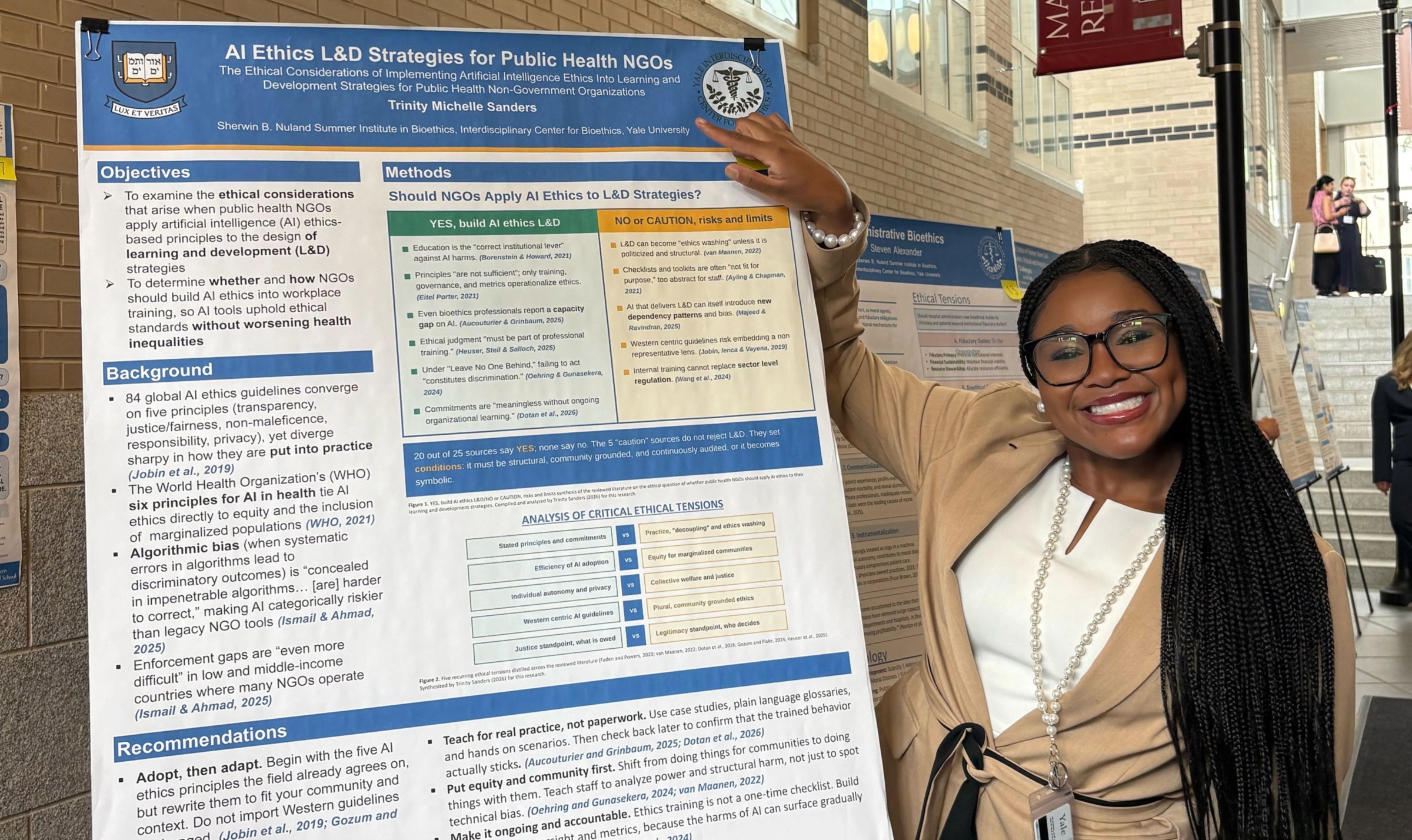
After graduation, Sanders spent the summer at Yale University’s Interdisciplinary Center for Bioethics, serving as a program manager and research student and examining how public health nonprofits can integrate AI ethics into learning and development strategies. She was invited to share her research with broader scholarly audiences, including an invitation to present at the 2026 Global Bioethics Summit in Portugal.
As this work evolved, Sanders found herself returning to a space that had long been central to her own life.
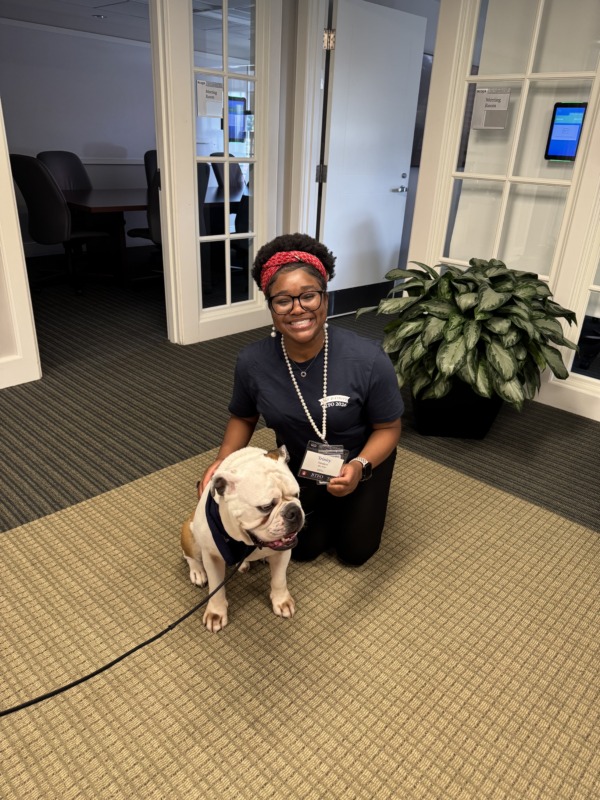
As the daughter of two ordained reverends, she grew up watching churches serve as centers of community and education. At Carolina, she remained active in ministry through First Baptist Church of Chapel Hill, a historically African American congregation on Rosemary Street.
She began asking whether faith communities were equipped to navigate the same ethical questions she was encountering in her work.
She found a significant gap. A 2026 survey by Exponential AI NEXT and ChurchTechToday found that 78% of churches use AI weekly or daily, yet 91% have no governance in place for its use.
“That means only 9% of U.S. churches have a written AI policy, while 100% of our communities will feel the consequences of that gap,” Sanders said.
Those questions led Sanders to Yale Divinity School. Now a first-year M.Div. student, Sanders is building on her background in leadership, bioethics, and public service while exploring how faith leaders can navigate emerging technologies in ways that are ethical, accountable, and centered on the people they serve.
The path from organizational leadership to artificial intelligence and ministry may appear unexpected, Sanders admits. But it all connects back to that question she developed during her time in the School of Education: “How can I best serve others?”
“If you were to tell me this is exactly where I would be, I would be confused,” she said. “But it’s the best place for me to be because this is the place of need that I don’t see a lot of individuals in, but I know I can make a large impact.”