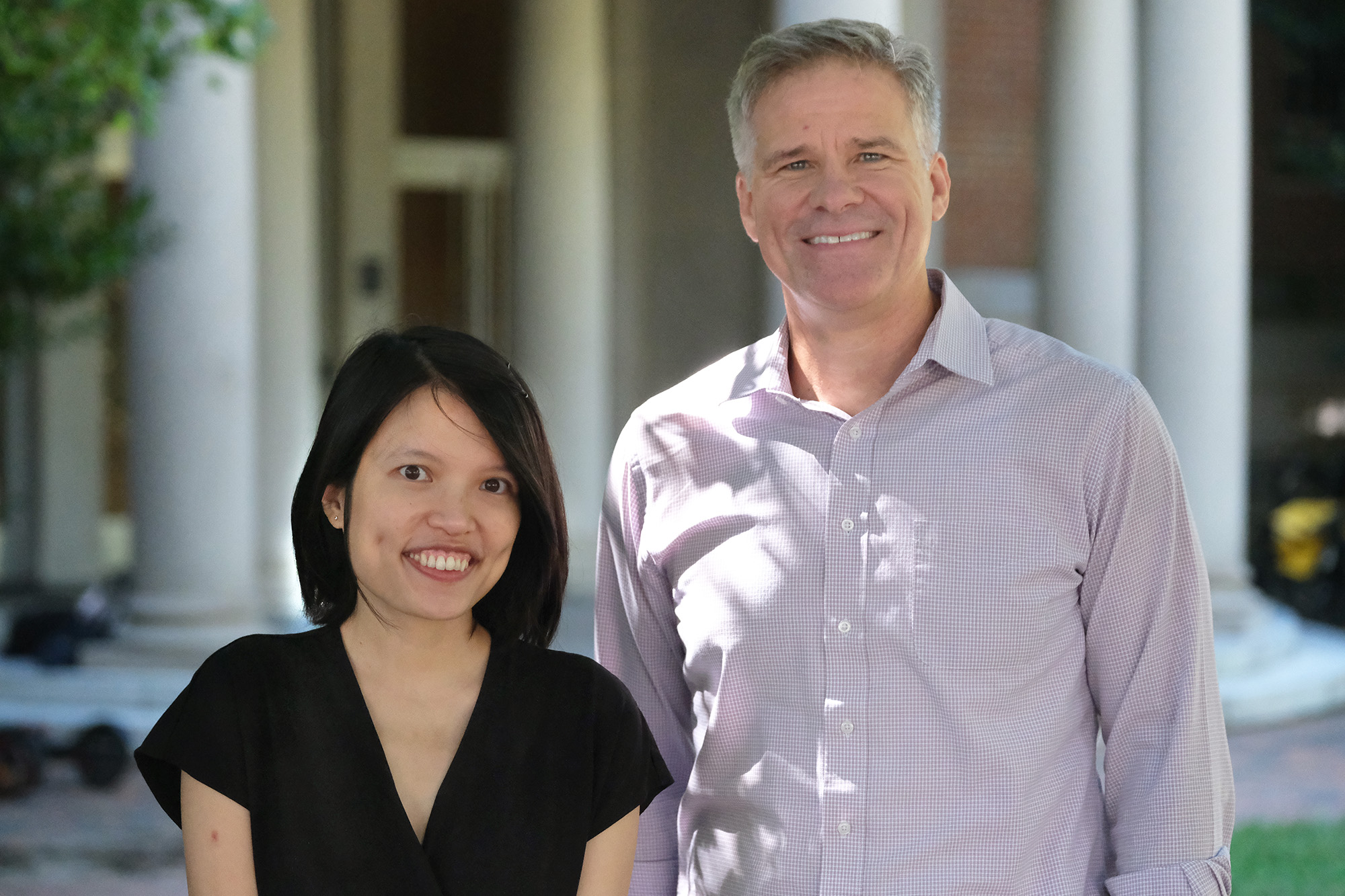
Ha Nguyen, Ph.D., an assistant professor at the UNC School of Education, leads work to understand how AI-powered learning technologies can support deeper student learning while ensuring those technologies enhance, rather than replace, meaningful human thinking, collaboration, and teacher support. A new award from the National Science Foundation will enable Nguyen to collaborate with high school science teachers in the creation of AI tools that enhance their teaching and their students’ learning.
The new $750,000 NSF award will provide Nguyen and co-Principal Investigator Troy D. Sadler, Ph.D., the Thomas James Distinguished Professor of Experiential Learning at the School, with funding to work closely with educators in the development of AI tools that will help high school science teachers plan more effective lessons, deliver improved in-the-moment feedback and instruction, and more accurately assess student learning.
The project builds on Nguyen’s previous NSF-funded research exploring ways AI — with multimodal capabilities to interpret various forms of student-generated learning artifacts — can help teachers better anticipate, understand, and respond to student learning. It also draws upon research conducted and data collected from Sadler’s NSF-funded work to implement scientific modeling focused on Grand Challenges such as pandemics, climate events, and biodiversity loss into science classroom lessons.
“In our work to bring AI tools to science classrooms, we realized that teachers are really excited about integrating these in the classroom, but they’re sometimes hesitant or need a little more practice with the tool or need assistance thinking about how to use the tool productively,” Nguyen said. “This project will help science teachers leverage AI to help students engage in authentic science practices.”
Those “authentic science practices,” Nguyen said, include data analysis and modeling —ideas some teachers need help delivering to their students in meaningful ways.
“When teachers center opportunities for students to engage in scientific practices like modeling they create classrooms where students reason about and make sense of complex phenomena and issues,” Sadler said. “This project is exciting because it gives us a chance to explore ways that we can use AI to achieve this form of innovative teaching and learning.
In the project’s first year, Nguyen and Sadler will work closely with teachers in Missouri to develop and refine the tool. Then, they will spend two years implementing the tool with science teachers in Missouri and North Carolina from a range of school districts, conducting case studies to study the tool’s effectiveness. While the project will directly involve 25 teachers and approximately 2,000 students, the team hopes the research will provide a roadmap for bringing similar AI-powered support to many more classrooms.
Nguyen said she believes that by centering educators in this work and by empowering teachers with novel ways to improve their instruction, the resulting AI tool can quickly find its way into more classrooms.
“I’m hopeful that this grant will speak to the fact that we can scale this technology in the classroom and more effectively support science teaching and learning,” Nguyen said.